Which molecule serves as the primary energy currency of the cell?
ATP (adenosine triphosphate) is the primary energy currency of the cell, providing energy for cellular processes.
What is the name of the molecule that stores and provides energy for cellular activities?
The molecule that stores and provides energy for cellular activities is called ATP (adenosine triphosphate).
Which energy molecule is used to power active transport in cells?
ATP (adenosine triphosphate) is the energy molecule that powers active transport in cells.
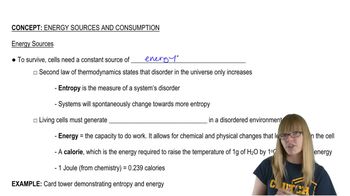
What does the second law of thermodynamics state regarding disorder in the universe?
The second law of thermodynamics states that disorder, or entropy, in the universe only increases. This means systems naturally progress toward greater disorder over time.
How is energy measured in biological systems, and what is the definition of a calorie?
Energy in biological systems is often measured in calories. A calorie is the amount of energy required to raise the temperature of 1 gram of water by 1 degree Celsius.
What is the difference between potential and kinetic energy in the context of cells?
Potential energy in cells is stored energy, such as in chemical bonds or concentration gradients. Kinetic energy is energy in motion, like heat, light, or moving electrons.
What are phototrophs and chemotrophs, and how do they obtain energy?
Phototrophs convert light energy into chemical energy through photosynthesis. Chemotrophs obtain energy by converting organic nutrients into usable energy.
What are the two main components of metabolism in cells?
The two main components of metabolism are catabolism, which breaks down food into smaller molecules, and anabolism, which synthesizes new molecules. Both processes are facilitated by enzymes.
What is the role of enzymes in cellular metabolism?
Enzymes are proteins that facilitate the breakdown and synthesis of molecules during metabolic reactions. They speed up chemical reactions necessary for cell survival.
How do oxidation and reduction differ in terms of electron transfer and energy?
Oxidation involves the removal of electrons from a molecule and releases energy. Reduction is the addition of electrons to a molecule and typically requires energy input.
 Back
Back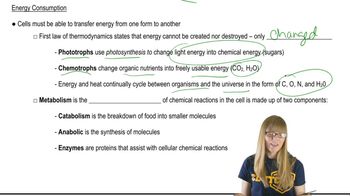
 04:45
04:45