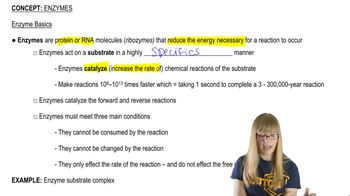
What is the general function of enzymes within a cell?
The general function of enzymes within a cell is to act as biological catalysts that speed up chemical reactions by lowering the activation energy required, without being consumed or altered in the process. This allows essential cellular reactions to occur rapidly and efficiently under physiological conditions.
What is the difference between the lock and key model and the induced fit model of enzyme-substrate interaction?
The lock and key model describes an enzyme and substrate with perfectly complementary shapes, while the induced fit model involves a conformational change in the enzyme to accommodate the substrate. Both models explain how enzymes achieve specificity in binding substrates.
How do enzymes affect the activation energy of a chemical reaction?
Enzymes lower the activation energy required for a reaction to proceed by stabilizing the transition state. This allows reactions to occur much faster than they would without enzymes.
What is a metastable state in the context of enzyme-catalyzed reactions?
A metastable state refers to molecules that are thermodynamically unstable and have a negative delta G but remain unchanged due to a high activation energy barrier. Enzymes help these molecules overcome the barrier and proceed to products.
Why is increasing temperature not a viable method for speeding up cellular reactions compared to using enzymes?
Increasing temperature can speed up reactions by raising kinetic energy, but it can be harmful or lethal to cells. Enzymes provide a safer and more efficient way to accelerate reactions without damaging cellular components.
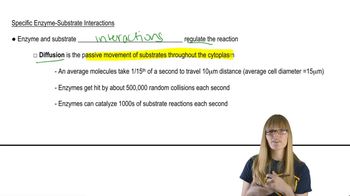
What role does diffusion play in enzyme-substrate interactions within a cell?
Diffusion allows substrates and enzymes to move and encounter each other within the cytoplasm, facilitating their interaction. This passive movement is essential for the high frequency of enzyme-catalyzed reactions in cells.
What is the function of cofactors or coenzymes in enzyme activity?
Cofactors or coenzymes are molecules that bind to enzymes and assist in catalyzing reactions. They can be organic or inorganic and are sometimes called prosthetic groups.
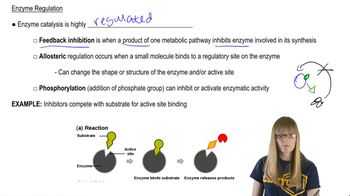
How does feedback inhibition regulate enzyme activity?
Feedback inhibition occurs when the product of a pathway inhibits the enzyme responsible for its synthesis. This prevents excess product formation and helps maintain cellular balance.
What is allosteric regulation of enzymes?
Allosteric regulation involves a small molecule binding to a regulatory site on the enzyme, altering its shape and affecting substrate binding or catalytic activity. This mechanism can inhibit or sometimes activate enzyme function.
How can phosphorylation influence enzyme activity?
Phosphorylation is the addition of a phosphate group to an enzyme, which can either activate or inhibit its activity. This modification is a common way cells regulate enzyme function in response to signals.