What are the defining structural features of eukaryotic cells that distinguish them from prokaryotic cells?
Eukaryotic cells have a nucleus enclosed by a nuclear envelope, membrane-bound organelles, a cytoskeleton, and a plasma membrane made of a lipid bilayer.
Describe the main functions of the rough and smooth endoplasmic reticulum in eukaryotic cells.
The rough endoplasmic reticulum synthesizes proteins due to its ribosome-studded surface, while the smooth endoplasmic reticulum is involved in lipid synthesis and lacks ribosomes.
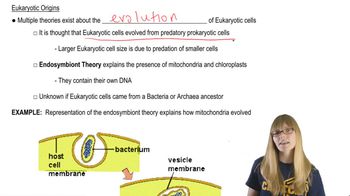
Explain the endosymbiont theory and its significance in the evolution of eukaryotic cells.
The endosymbiont theory proposes that mitochondria and chloroplasts originated from smaller prokaryotic cells engulfed by larger ones, leading to the evolution of complex eukaryotic cells.
What are the three main components of the eukaryotic cytoskeleton, and what are their primary functions?
The three main cytoskeletal components are microtubules (cell shape and motility), microfilaments/actin filaments (muscle contraction and cell movement), and intermediate filaments (structural support).
How is eukaryotic DNA organized and how does this organization contribute to gene expression control?
Eukaryotic DNA is organized into linear chromosomes and packaged with histone proteins, forming chromatin. This packaging allows efficient storage and separates transcription (in the nucleus) from translation (in the cytoplasm), enabling tight gene expression control.
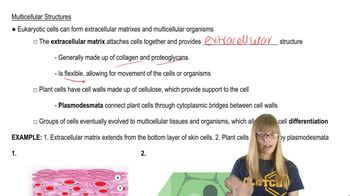
How do eukaryotic cells connect and communicate in multicellular organisms, and what structures are involved in animals and plants?
Eukaryotic cells connect and communicate through the extracellular matrix (ECM) in animals, which is flexible and protein-based, and through plasmodesmata in plants, which are cytoplasmic bridges between cell walls.
What structural features distinguish eukaryotic cells from prokaryotic cells?
Eukaryotic cells have a nucleus enclosed by a nuclear envelope, membrane-bound organelles, a cytoskeleton, and a plasma membrane made of a lipid bilayer.
What are the main functions of the rough and smooth endoplasmic reticulum in eukaryotic cells?
The rough endoplasmic reticulum synthesizes proteins due to its ribosome-studded surface, while the smooth endoplasmic reticulum is involved in lipid synthesis and lacks ribosomes.
What is the endosymbiont theory and why is it significant for eukaryotic cell evolution?
The endosymbiont theory proposes that mitochondria and chloroplasts originated from smaller prokaryotic cells engulfed by larger ones, leading to the evolution of complex eukaryotic cells.
How do eukaryotic cells connect and communicate in multicellular organisms, and what structures are involved in animals and plants?
Eukaryotic cells connect and communicate through the extracellular matrix (ECM) in animals, which is flexible and protein-based, and through plasmodesmata in plants, which are cytoplasmic bridges between cell walls.
What is the jelly-like substance found inside a eukaryotic cell?
The jelly-like substance inside a eukaryotic cell is called cytosol.
What is considered the control center of a eukaryotic cell?
The nucleus is considered the control center of a eukaryotic cell.
Where is DNA located in a eukaryotic cell?
DNA in a eukaryotic cell is primarily located in the nucleus.
What is the function of the cell wall in eukaryotic cells?
The cell wall provides structural support and protection to the cell.
Which organelle acts as the control center of the cell?
The nucleus acts as the control center of the cell.
In which organelle is most DNA found in a eukaryotic cell?
Most DNA in a eukaryotic cell is found in the nucleus.
Where is the DNA in a eukaryotic cell typically found?
DNA is typically found in the nucleus of a eukaryotic cell.
Which organelle is DNA usually found in within eukaryotic cells?
DNA is usually found in the nucleus within eukaryotic cells.
Where can DNA be found in a eukaryotic cell?
DNA can be found in the nucleus and, in smaller amounts, in mitochondria and chloroplasts.
What is the part of a nerve cell that contains the nucleus called?
The part of a nerve cell containing the nucleus is called the cell body (soma).
What organelle is DNA found in within eukaryotic cells?
DNA is found in the nucleus, and also in mitochondria and chloroplasts.
What structure controls the cell's activities?
The nucleus controls the cell's activities.
Which part of the cell is considered the control center?
The nucleus is considered the control center of the cell.
What is the portion of the cell outside the nucleus called?
The portion of the cell outside the nucleus is called the cytoplasm.
Where is DNA found in a eukaryotic cell?
DNA is found in the nucleus of a eukaryotic cell.
What is the jelly-like substance in a cell called?
The jelly-like substance in a cell is called cytosol.
What is the portion of the cell outside the nucleus?
The portion of the cell outside the nucleus is the cytoplasm.
Where is the DNA located in a eukaryotic cell?
DNA is located in the nucleus of a eukaryotic cell.
What is a jelly-like substance in a cell?
A jelly-like substance in a cell is cytosol.
What is the portion of the cell outside the nucleus called?
The portion of the cell outside the nucleus is called the cytoplasm.
What do the cell walls of fungi contain?
The cell walls of fungi contain chitin.
What is the control center of the cell?
The control center of the cell is the nucleus.
What is the control center of a cell called?
The control center of a cell is called the nucleus.
Which multicellular eukaryotes have cell walls and are autotrophic?
Plants are multicellular eukaryotes that have cell walls and are autotrophic.
What is the control center of the cell?
The nucleus is the control center of the cell.
What is the rigid outer layer of a plant cell called?
The rigid outer layer of a plant cell is called the cell wall.
What is the cell wall of fungi made of?
The cell wall of fungi is made of chitin.
Which part of the cell is the control center?
The nucleus is the control center of the cell.
What is the portion of the cell outside the nucleus?
The portion of the cell outside the nucleus is the cytoplasm.
Where is the nucleus located in a neuron?
The nucleus in a neuron is located in the cell body (soma).
 Back
Back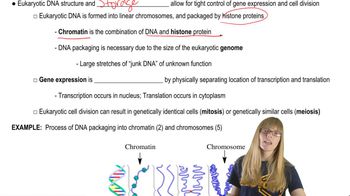
 03:05
03:05