Pearson+ LogoPearson+ Logo

Evolution of the Cell quiz #1 Flashcards

Back
Evolution of the Cell quiz #1
Control buttons has been changed to "navigation" mode.
1/10
  • What is the best current explanation for how mitochondria and chloroplasts originated in eukaryotic cells?

    The best explanation is the endosymbiotic theory, which states that mitochondria and chloroplasts originated when larger prokaryotic cells engulfed smaller prokaryotic cells that survived inside them and eventually evolved into these organelles.
  • From what type of organism did mitochondria most likely originate?

    Mitochondria most likely originated from smaller prokaryotic cells that were engulfed by larger cells, according to the endosymbiotic theory.
  • According to current scientific understanding, from which group of organisms did mitochondria evolve?

    Mitochondria evolved from prokaryotic cells that were engulfed by larger cells and survived inside them, eventually becoming organelles.
  • How did mitochondria evolve within eukaryotic cells?

    Mitochondria evolved when a larger prokaryotic cell engulfed a smaller prokaryotic cell, which survived and became a permanent resident, eventually evolving into the mitochondrion.
  • How did chloroplasts become present in the cells of producers such as plants?

    Chloroplasts became present in producer cells through the endosymbiotic theory, where a larger cell engulfed a smaller photosynthetic prokaryote, which survived and evolved into the chloroplast.
  • What process explains the presence of chloroplasts in the cells of producers?

    The presence of chloroplasts in producer cells is explained by the endosymbiotic theory, where a larger cell engulfed a photosynthetic prokaryote that survived and became the chloroplast.
  • What molecular evidence supports the idea that all organisms originated from a single ancestral cell?

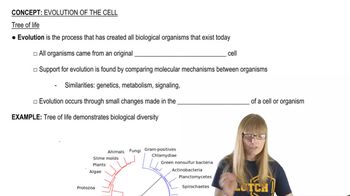
    All organisms share common molecular mechanisms such as the genetic code and metabolic chemical reactions. These similarities suggest a single ancestral origin for all life forms.
  • Why are ribosomal RNA sequences used to study evolutionary relationships among organisms?

    Ribosomal RNA sequences are present in every organism and change very little over time. This makes them useful for distinguishing between different organisms, especially among prokaryotes.
  • How does horizontal gene transfer contribute to genetic diversity in bacteria?

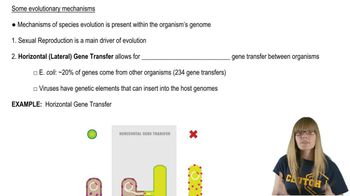
    Horizontal gene transfer allows bacteria to acquire DNA from other organisms, leading to new genetic combinations. This process is a major driver of evolution and genetic diversity in bacterial populations.
  • What is the significance of highly conserved genes in evolutionary studies?

    Highly conserved genes have low mutation rates because changes often harm the organism. Their presence across diverse species indicates their essential function and importance in life.