Is exocytosis an example of active or passive transport in cells?
Exocytosis is an example of active transport, as it requires energy to move vesicles and fuse them with the plasma membrane to release substances outside the cell.
What is the process by which a cell removes substances using a vesicle?
The process by which a cell removes substances using a vesicle is called exocytosis.
How does an axon release dopamine outside of the cell?
An axon releases dopamine outside of the cell through exocytosis, where vesicles containing dopamine fuse with the plasma membrane and release their contents into the extracellular space.
Is exocytosis considered passive or active transport?
Exocytosis is considered active transport because it requires energy for vesicle movement and membrane fusion.
Where are neurotransmitters stored within a cell before their release?
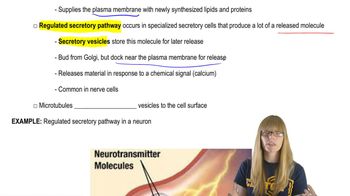
Neurotransmitters are stored in secretory vesicles within the cell before their release.
What is the process by which a cell releases large amounts of material?
The process by which a cell releases large amounts of material is called exocytosis.
How does a cell expel wastes from a vacuole?
A cell expels wastes from a vacuole through exocytosis, where the vacuole fuses with the plasma membrane and releases its contents outside the cell.
Which cellular process is responsible for removing materials from a cell?
Exocytosis is the cellular process responsible for removing materials from a cell.
In which cellular structures are neurotransmitters stored prior to exocytosis?
Neurotransmitters are stored in secretory vesicles prior to exocytosis.
What role do microtubules play in the process of exocytosis?
Microtubules guide vesicles carrying cargo to the cell surface during exocytosis. This ensures that vesicles reach the correct area of the plasma membrane for fusion and content release.