Which biomolecules serve as energy storage in cells?
Polysaccharides (such as starch in plants and glycogen in animals) and fats (triglycerides) act as energy storage molecules in cells.
Which type of macromolecule is primarily responsible for regulating cell processes?
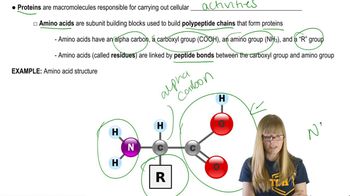
Proteins are the macromolecules that primarily regulate cell processes by carrying out cellular activities.
What is the structural difference between a triglyceride and a phospholipid?
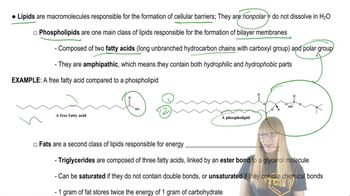
A triglyceride consists of three fatty acids linked to a glycerol molecule, while a phospholipid has two fatty acids and a polar group attached to a glycerol backbone, making it amphipathic with both hydrophilic and hydrophobic regions.
How does a phospholipid differ from a triglyceride in terms of structure and function?
A phospholipid has two fatty acids and a polar group, making it amphipathic and suitable for forming cell membranes, while a triglyceride has three fatty acids and functions mainly in energy storage.
In what way is a phospholipid different from a triglyceride?
A phospholipid contains two fatty acids and a polar group, enabling it to form cellular membranes, whereas a triglyceride has three fatty acids and is used for energy storage.
What type of bond links monosaccharides together in polysaccharides?
Monosaccharides are linked by glycosidic bonds, which form between a carbon and hydroxyl group on each monosaccharide. These bonds create the structure of polysaccharides.
Which two main classes of monosaccharides are distinguished by the position of the carbonyl group?
The two main classes are aldose, with the carbonyl group at the end, and ketose, with the carbonyl group in the middle. This classification is based on the carbonyl group's position within the molecule.
What type of bond connects nucleotides in nucleic acids?
Nucleotides are connected by phosphodiester bonds in nucleic acids. These bonds link the phosphate group of one nucleotide to the sugar of another.
Which amino acid forms disulfide bridges that stabilize protein structure?
Cysteine is the amino acid that forms disulfide bridges through its sulfhydryl groups. These bridges provide strong stabilization to protein structures.
How does the saturation of fatty acids affect the properties of fats?
Saturated fatty acids have no double bonds, while unsaturated fatty acids contain double bonds. The presence or absence of double bonds influences the rigidity and flexibility of fat molecules.
 Back
Back
 04:36
04:36