Pearson+ LogoPearson+ Logo

Golgi Processing and Transport quiz #1 Flashcards

Back
Golgi Processing and Transport quiz #1
Control buttons has been changed to "navigation" mode.
1/36
  • What are the main functions of the Golgi apparatus in protein processing and transport within the cell?

    The Golgi apparatus modifies proteins (mainly through glycosylation), sorts them, and directs their transport to various destinations. It acts as a hub for both anterograde (ER to plasma membrane) and retrograde (plasma membrane to ER) transport, ensuring proteins are properly processed and sent to the correct location.
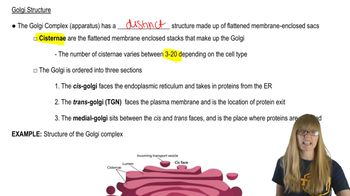
  • Describe the structural organization of the Golgi apparatus and the significance of its different regions.

    The Golgi apparatus is composed of flattened membrane-bound stacks called cisternae, organized into cis (facing the ER), medial (middle), and trans (facing the plasma membrane) regions. Each region is responsible for specific protein modifications and sorting functions.
  • How do proteins move through the Golgi apparatus, and what are the two main models explaining this movement?

    Proteins move through the Golgi via a combination of the vesicular transport model (proteins move in vesicles between stationary cisternae) and the cisternae maturation model (cisternae themselves move and mature from cis to trans). Current evidence suggests both models operate together.
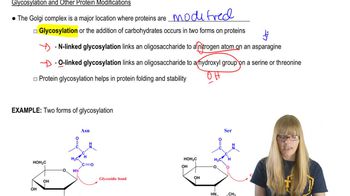
  • What is glycosylation, and what types occur in the Golgi apparatus?

    Glycosylation is the addition of carbohydrate groups to proteins. In the Golgi, both N-linked (sugar attached to a nitrogen atom) and O-linked (sugar attached to a hydroxyl group) glycosylation occur, with terminal glycosylation being the final modification before proteins leave the Golgi.
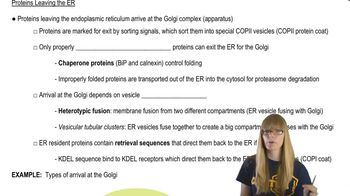
  • What happens to misfolded proteins in the ER, and how does the cell ensure only properly folded proteins reach the Golgi?

    Misfolded proteins in the ER are recognized by chaperone proteins and targeted for degradation by the proteasome. Only properly folded proteins, marked by sorting signals, are packaged into COP II vesicles for transport to the Golgi.
  • What is the role of retrieval sequences like KDEL in protein transport between the ER and Golgi?

    Retrieval sequences such as KDEL act as tags on proteins that mistakenly leave the ER, directing them to be returned from the Golgi back to the ER via specific vesicles.
  • Differentiate between anterograde and retrograde transport in the context of the Golgi apparatus.

    Anterograde transport moves proteins from the ER through the Golgi to the plasma membrane, while retrograde transport moves proteins from the plasma membrane or Golgi back to the ER. The Golgi uses sorting signals and receptors to direct these pathways.
  • What is the role of COP II vesicles in protein transport from the ER to the Golgi apparatus?

    COP II vesicles transport properly folded proteins marked with sorting signals from the ER to the Golgi apparatus. Only proteins that are correctly folded and processed are packaged into these vesicles for export.
  • How are the cis, medial, and trans regions of the Golgi apparatus organized, and what is their significance?

    The Golgi apparatus is organized into cis (facing the ER), medial (middle), and trans (facing the plasma membrane) regions, each made up of flattened stacks called cisternae. Each region is responsible for specific protein modifications and sorting functions.
  • What are the two main models explaining how proteins move through the Golgi apparatus?

    The vesicular transport model suggests proteins move in vesicles between stationary cisternae, while the cisternae maturation model proposes that cisternae themselves move and mature from cis to trans. Current evidence indicates that both models operate together in protein transport through the Golgi.
  • What type of package is created by the Golgi apparatus for transporting proteins?

    The Golgi apparatus creates vesicles that package proteins for transport within or out of the cell.
  • Which organelle is responsible for modifying and packaging proteins in eukaryotic cells?

    The Golgi apparatus modifies and packages proteins in eukaryotic cells.
  • Is the Golgi apparatus found in eukaryotic or prokaryotic cells?

    The Golgi apparatus is found in eukaryotic cells, not prokaryotic cells.
  • Which organelle packages materials to leave the cell?

    The Golgi apparatus packages materials, such as proteins, to leave the cell.
  • What is the main function of the Golgi apparatus in an animal cell?

    In animal cells, the Golgi apparatus modifies, sorts, and packages proteins and lipids for delivery to their destinations.
  • Which organelle is often referred to as the 'post office' of the cell?

    The Golgi apparatus is often called the 'post office' of the cell because it sorts and packages proteins for transport.
  • Which organelle modifies, sorts, and packages proteins for transport?

    The Golgi apparatus modifies, sorts, and packages proteins for transport.
  • Which organelle completes protein modifications and packages them for delivery?

    The Golgi apparatus completes protein modifications and packages them for delivery.
  • Which organelle functions as a sorting hub for proteins in the cell?

    The Golgi apparatus functions as a sorting hub for proteins, directing them to their proper destinations.
  • What is a key function of the Golgi apparatus?

    A key function of the Golgi apparatus is to modify, sort, and package proteins and lipids for transport.
  • Which organelle sorts, modifies, and packages proteins within a cell?

    The Golgi apparatus sorts, modifies, and packages proteins within a cell.
  • What part of the cell sorts and packages proteins for transport?

    The Golgi apparatus sorts and packages proteins for transport.
  • What organelle packages proteins for delivery to other parts of the cell or outside the cell?

    The Golgi apparatus packages proteins for delivery to other parts of the cell or outside the cell.
  • What is the function of the Golgi apparatus?

    The Golgi apparatus modifies, sorts, and packages proteins and lipids for transport to their destinations.
  • What is the function of the Golgi body?

    The Golgi body (apparatus) modifies, sorts, and packages proteins and lipids for transport.
  • What does the Golgi apparatus do in the cell?

    The Golgi apparatus processes, modifies, sorts, and packages proteins and lipids for transport.
  • What do Golgi bodies do in eukaryotic cells?

    Golgi bodies modify, sort, and package proteins and lipids for transport within or outside the cell.
  • Is the Golgi apparatus present in plant or animal cells?

    The Golgi apparatus is present in both plant and animal eukaryotic cells.
  • Which organelle functions to package and deliver proteins in the cell?

    The Golgi apparatus functions to package and deliver proteins in the cell.
  • How does the Golgi apparatus contribute to protein transport in the cell?

    The Golgi apparatus modifies, sorts, and packages proteins into vesicles for transport to their destinations.
  • What are the main structural regions of the Golgi apparatus?

    The Golgi apparatus has three main regions: the cis face (adjacent to the ER), the medial section, and the trans face (oriented toward the plasma membrane).
  • What types of protein modifications occur in the Golgi apparatus?

    Proteins in the Golgi apparatus undergo modifications such as glycosylation, including N-linked and O-linked glycosylation, and terminal glycosylation.
  • What is terminal glycosylation and where does it occur?

    Terminal glycosylation is the final modification of glycosylation that occurs in the Golgi apparatus, important for protein folding and stability.
  • What are the two main models for protein transport through the Golgi apparatus?

    The two main models for protein transport through the Golgi are the vesicular transport model and the cisternae maturation model.
  • What is the difference between anterograde and retrograde transport in the Golgi apparatus?

    Anterograde transport moves proteins from the ER to the Golgi and toward the plasma membrane, while retrograde transport moves proteins from the plasma membrane to the Golgi and back to the ER.
  • How does the Golgi apparatus recognize and sort proteins for transport?

    The Golgi apparatus uses protein receptors that recognize sorting signals on proteins to direct them into appropriate vesicles for transport.