What type of genetic mutation causes sickle cell anemia?
Sickle cell anemia is caused by a single nucleotide polymorphism (SNP), which is a point mutation in the gene encoding the beta-globin subunit of hemoglobin.
Sickle cell anemia is a type of what genetic mutation?
Sickle cell anemia is a type of single nucleotide polymorphism (SNP), specifically a point mutation.
Which specific mutation leads to the development of sickle cell anemia?
Sickle cell anemia results from a single nucleotide change (SNP) in the beta-globin gene, causing the substitution of valine for glutamic acid in the hemoglobin protein.
What type of mutation is responsible for sickle cell disease?
Sickle cell disease is caused by a single nucleotide polymorphism (SNP), which is a point mutation in the beta-globin gene.
What percentage of the human genome is highly conserved across most organisms, and what is notable about its function?
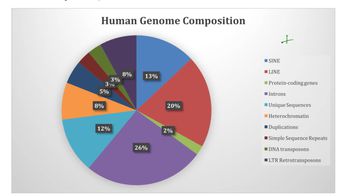
Five percent of the human genome is highly conserved across most organisms. Of this, 3% is conserved but its function remains largely unknown.
How does the proportion of protein-coding DNA in humans compare to that in bacteria?
Less than 2% of the human genome encodes proteins, while about 90% of the bacterial genome is protein-coding. This highlights a major difference in genome composition between humans and bacteria.
What are human accelerated regions and what role do they play in human evolution?
Human accelerated regions are conserved genomic areas that underwent rapid evolution after humans diverged from chimpanzees. About 25% of these regions are involved in genes controlling brain development.
What is the significance of CA repeats in human genetic variation and forensic science?
CA repeats are strings of repeating cytosine and adenine nucleotides that vary greatly between individuals. Their variability is used in DNA fingerprinting to identify individuals in forensic investigations.
How does genome size relate to organism complexity according to comparative genomics?
Genome size does not dictate organism complexity, as shown by the varying proportions of protein-coding DNA among different species. For example, flowering plants have a similar number of genes to humans but a different genome size and coding percentage.
What types of genetic variation contribute to differences among human populations?
Genetic variation among human populations includes single nucleotide polymorphisms (SNPs), copy number variations, and CA repeats. These variations account for traits such as hair color, eye color, and height.
 Back
Back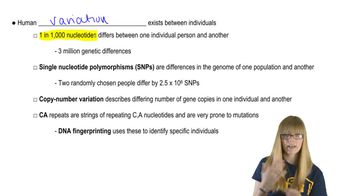
 05:22
05:22