Skip to main content
Cell Biology
My Course
Learn
Exam Prep
AI Tutor
Study Guides
Flashcards
Explore
Try the app
My Course
Learn
Exam Prep
AI Tutor
Study Guides
Flashcards
Explore
Try the app
Back
Intermediate Filaments quiz
You can tap to flip the card.
What is the primary function of intermediate filaments in cells?
You can tap to flip the card.
👆
What is the primary function of intermediate filaments in cells?
Intermediate filaments provide tensile strength, making cells durable and able to withstand mechanical stresses like pulling, pushing, and twisting.
Track progress
Control buttons has been changed to "navigation" mode.
1/15
Related flashcards
Related practice
Recommended videos
Intermediate Filaments definitions
Intermediate Filaments
15 Terms
Intermediate Filaments
15. Cytoskeleton and Cell Movement
7 problems
Topic
Microtubules
15. Cytoskeleton and Cell Movement
7 problems
Topic
15. Cytoskeleton and Cell Movement - Part 1 of 2
5 topics
14 problems
Chapter
15. Cytoskeleton and Cell Movement - Part 2 of 2
5 topics
13 problems
Chapter
Guided course
04:42
Intermediate Filaments
735
views
10
rank
Terms in this set (15)
Hide definitions
What is the primary function of intermediate filaments in cells?
Intermediate filaments provide tensile strength, making cells durable and able to withstand mechanical stresses like pulling, pushing, and twisting.
How do intermediate filaments compare in durability to other cytoskeletal filaments?
Intermediate filaments are the most durable cytoskeletal filaments, allowing cells to resist breaking under mechanical stress.
What structural analogy is used to describe intermediate filaments and their function?
Intermediate filaments are compared to ropes, as they can be pulled, pushed, or twisted without breaking, similar to how a rope behaves.
To which cellular structures are intermediate filaments anchored?
Intermediate filaments are anchored to the plasma membrane and the nucleus.
What is the basic building block (smallest subunit) of intermediate filaments?
The basic building block is a subunit, which forms a monomer.
How do two intermediate filament subunits interact to form a dimer?
Two subunits form a dimer by binding through their alpha helical domains.
What is formed when two dimers of intermediate filaments arrange in an antiparallel manner?
When two dimers arrange antiparallel, they form a tetramer.
What unique feature do the ends of intermediate filaments have compared to other cytoskeletal elements?
Both ends of intermediate filaments are the same, which is unique among cytoskeletal elements.
What can mutations or defects in intermediate filaments lead to?
Mutations or defects can cause severe diseases such as ALS (Amyotrophic Lateral Sclerosis) and Progerias (advanced aging).
Name the four classes of intermediate filaments.
The four classes are keratin, vimentin and related, neurofilaments, and nuclear lamins.
Where are keratin intermediate filaments primarily found?
Keratin filaments are found in epithelial cells, such as skin cells.
Where are vimentin and related intermediate filaments located in the cell?
Vimentin and related filaments are found from the nucleus to the cell periphery.
In which type of cell are neurofilaments found?
Neurofilaments are found in neurons.
What is the role of nuclear lamins?
Nuclear lamins support the nucleus.
Why is it important for intermediate filaments to have the same ends?
Having the same ends is a unique structural feature that distinguishes intermediate filaments from other cytoskeletal elements.
 BackBack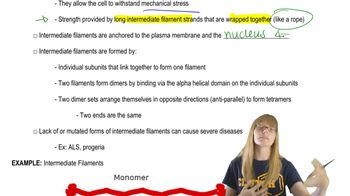
 04:42
04:42