Pearson+ LogoPearson+ Logo

Light Dependent Reactions quiz #1 Flashcards

Back
Light Dependent Reactions quiz #1
Control buttons has been changed to "navigation" mode.
1/10
  • How do chloroplasts capture energy from the sun during the light-dependent reactions of photosynthesis?

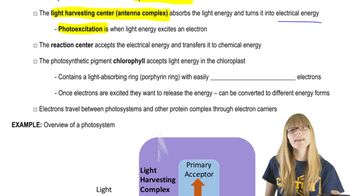
    Chloroplasts capture energy from the sun using photosystems located in the thylakoid membrane. Light photons are absorbed by chlorophyll pigments in the light-harvesting complexes, exciting electrons through photoexcitation. This energy is transferred to a special pair of chlorophyll molecules in the reaction center, where it is converted from light energy to electrical energy and then to chemical energy. The excited electrons are passed through an electron transport chain, leading to the production of ATP and NADPH, which are used in later stages of photosynthesis.
  • What are the two main regions of a photosystem involved in the light-dependent reactions?

    The two main regions are the light-harvesting complex (antenna complex) and the reaction center. The light-harvesting complex absorbs light energy, while the reaction center converts it to chemical energy.
  • Why can chlorophyll molecules absorb light energy so effectively?

    Chlorophyll molecules have a unique chemical structure with a light-absorbing ring called a porphyrin ring. This structure contains easily excitable electrons that respond quickly to light energy.
  • What is resonance energy transfer in the context of photosystems?

    Resonance energy transfer is the process where energy, not the electron itself, is transferred between adjacent chlorophyll molecules. This energy eventually reaches the special pair in the reaction center.
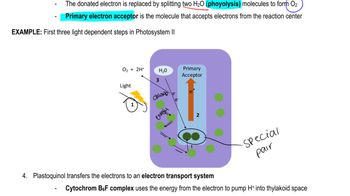
  • How is the excited electron in Photosystem II replaced after it is transferred to plastoquinone?

    The excited electron is replaced by electrons derived from the splitting of water in a process called photolysis. This reaction also releases oxygen as a byproduct.
  • What role does the cytochrome b6f complex play in the light-dependent reactions?

    The cytochrome b6f complex receives excited electrons and uses their energy to pump hydrogen protons into the thylakoid space. This creates an electrochemical gradient necessary for ATP synthesis.
  • Which electron carrier receives electrons from the cytochrome b6f complex before they reach Photosystem I?

    Plastocyanin receives electrons from the cytochrome b6f complex. It then transfers these electrons to the special pair in Photosystem I.
  • What is the final electron acceptor in the linear light-dependent pathway, and what is produced as a result?

    The final electron acceptor is NADP+ reductase, which receives electrons from ferredoxin. This results in the production of NADPH in the stroma.
  • How does ATP synthase generate ATP during the light-dependent reactions?

    ATP synthase uses the electrochemical gradient of hydrogen protons created by proton pumping. As protons flow through ATP synthase, ATP is synthesized from ADP and inorganic phosphate.
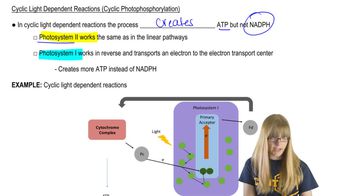
  • How does the cyclic light-dependent pathway differ from the linear pathway in terms of electron flow and products?

    In the cyclic pathway, electrons from Photosystem I are cycled back to the cytochrome complex instead of moving to NADP+ reductase. This pathway produces ATP but not NADPH.