Is sickle cell anemia an example of codominance according to Mendelian inheritance principles?
No, sickle cell anemia is not an example of codominance according to Mendelian inheritance principles. Mendelian inheritance typically describes traits as dominant or recessive, but codominance refers to a situation where both alleles are fully expressed in the phenotype. Sickle cell anemia is more accurately described as an example of incomplete dominance, where heterozygotes show an intermediate phenotype. The provided materials do not discuss codominance or sickle cell anemia specifically.
What does it mean for an individual to be homozygous for a gene?
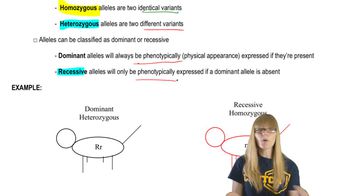
An individual is homozygous for a gene if both alleles for that gene are identical. This means they have two copies of the same allele.
How are dominant alleles expressed in the phenotype when paired with a recessive allele?
Dominant alleles are always expressed in the phenotype, even if paired with a recessive allele. The physical trait associated with the dominant allele will be visible.
What is the F2 generation in Mendel’s experiments, and how is it produced?
The F2 generation is the offspring produced by mating F1 individuals, which are the children of the original parental (P1) generation. In plants, F2 can result from crossing F1 siblings or F1 individuals with their parents.
What does Mendel’s law of segregation state about allele inheritance during gamete formation?
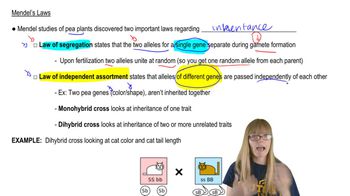
Mendel’s law of segregation states that only one allele from each parent is passed to the offspring during gamete formation. This prevents doubling of genetic information in the offspring.
How does the law of independent assortment affect the inheritance of traits controlled by different genes?
The law of independent assortment states that alleles of different genes are passed independently of each other. This allows for varied combinations of traits in offspring.
Why might genes located close together on the same chromosome not assort independently?
Genes close together on the same chromosome tend to be inherited together due to genetic linkage. This is because crossing over is less likely to separate them during meiosis.
What is genetic linkage and how is it measured in genetic studies?
Genetic linkage refers to the tendency of genes located near each other on a chromosome to be inherited together. It is measured by observing how frequently certain traits are co-inherited in a population.
How does crossing over during meiosis influence the inheritance of genes on the same chromosome?
Crossing over allows genes that are far apart on the same chromosome to be inherited independently. If genes are close together, crossing over is less likely to separate them, so they are often co-inherited.
What is a monohybrid cross and how does it differ from a dihybrid cross?
A monohybrid cross examines the inheritance of a single trait, while a dihybrid cross studies the inheritance of two traits simultaneously. Dihybrid crosses reveal how traits controlled by different genes assort independently.