What cytoskeletal structure consists of hollow tubes that provide support for the cell?
Microtubules are cytoskeletal elements composed of tubulin dimers that form hollow tubes, providing structural support for the cell.
What role do microtubules play in intracellular transport?
Microtubules act as cellular tracks that move vesicles and organelles throughout the cell. This transport is essential for proper cellular function and organization.
How does the arrangement of alpha and beta tubulin subunits contribute to microtubule polarity?
The alpha subunit is positioned at the minus end and the beta subunit at the plus end, giving the microtubule structural polarity. This polarity determines the direction of growth and shrinkage.
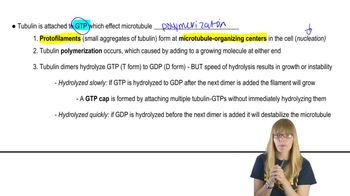
What is the significance of the GTP cap in microtubule growth?
The GTP cap stabilizes the plus end of the microtubule, allowing rapid addition of tubulin dimers. Without the GTP cap, the microtubule end becomes unstable and prone to depolymerization.
What is the process of nucleation in microtubule formation?
Nucleation is the initial aggregation of tubulin subunits at microtubule organizing centers, allowing microtubule growth to begin. It is distinct from the cell nucleus and is essential for microtubule assembly.
How do microtubule associated proteins (MAPs) affect microtubule stability?
MAPs bind to microtubules and stabilize them against disassembly when breakdown is not required. This regulation helps maintain the integrity of the cytoskeleton.
What is dynamic instability in the context of microtubules?
Dynamic instability refers to the switching of a microtubule end between growth (polymerization) and shrinkage (depolymerization). This process is regulated by the presence of GTP or GDP-bound tubulin at the microtubule end.
How does treadmilling differ from dynamic instability in microtubule behavior?
Treadmilling involves the addition of tubulin subunits at the plus end and loss at the minus end, resulting in movement of subunits through the microtubule. Dynamic instability focuses on changes at a single end, while treadmilling involves both ends.
What function do centrosomes serve during cell division?
Centrosomes organize microtubule arrays that ensure equal distribution of DNA and organelles between daughter cells. They contain centrioles that act as nucleation sites for microtubule growth.
How are centrioles structurally arranged within centrosomes?
Centrioles are arranged as pairs, each composed of triplet microtubule structures. This unique arrangement provides the nucleation sites for microtubule growth during cell division.
 Back
Back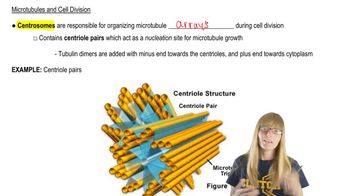
 02:05
02:05