Skip to main content
Cell Biology
My Course
Learn
Exam Prep
AI Tutor
Study Guides
Flashcards
Explore
Try the app
My Course
Learn
Exam Prep
AI Tutor
Study Guides
Flashcards
Explore
Try the app
Back
Mitosis quiz #7
You can tap to flip the card.
Mitosis begins in which cell organelle?
You can tap to flip the card.
👆
Mitosis begins in which cell organelle?
Mitosis begins in the nucleus.
Track progress
Control buttons has been changed to "navigation" mode.
1/27
Related flashcards
Related practice
Recommended videos
Mitosis quiz #1
Mitosis
40 Terms
Mitosis quiz #2
Mitosis
40 Terms
Mitosis quiz #3
Mitosis
40 Terms
Mitosis
16. Cell Division
7 problems
Topic
Cytokinesis
16. Cell Division
7 problems
Topic
16. Cell Division - Part 1 of 2
5 topics
14 problems
Chapter
16. Cell Division - Part 2 of 2
5 topics
13 problems
Chapter
Guided course
07:03
Mitosis Steps
613
views
4
rank
1
comments
Guided course
08:29
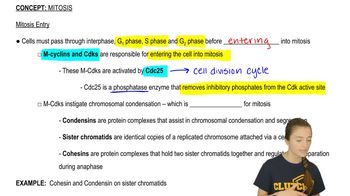
Mitosis Entry
755
views
16
rank
Terms in this set (27)
Hide definitions
Mitosis begins in which cell organelle?
Mitosis begins in the nucleus.
Which is true about a daughter cell produced by mitosis?
A daughter cell produced by mitosis is genetically identical to the parent cell.
Which best describes the daughter cells produced by mitosis?
The daughter cells are genetically identical to each other and to the parent cell.
What is a phase of mitosis?
Prophase is a phase of mitosis.
Mitosis is the process by which what occurs?
Mitosis is the process by which a cell divides its nucleus to produce two identical nuclei.
How is binary fission different from mitosis?
Binary fission occurs in prokaryotes and does not involve a nucleus, while mitosis occurs in eukaryotes and involves nuclear division.
How many cells are at the end of mitosis?
There are two cells at the end of mitosis.
After mitosis, how many daughter cells are produced?
Two daughter cells are produced after mitosis.
How many times does mitosis go through PMAT?
Mitosis goes through PMAT (prophase, metaphase, anaphase, telophase) once per division.
How many cells are created at the end of mitosis?
Two cells are created at the end of mitosis.
How many times does PMAT occur in mitosis?
PMAT occurs once in each mitotic division.
How does mitosis maintain the chromosome number?
Mitosis maintains chromosome number by equally dividing replicated chromosomes into two daughter cells.
At the end of mitosis, how many cells are there?
There are two cells at the end of mitosis.
How many chromosomes are in each daughter cell after mitosis?
Each daughter cell has the same number of chromosomes as the parent cell.
How many chromosomes does each daughter cell have after mitosis?
Each daughter cell has the same number of chromosomes as the parent cell.
How many chromosomes are in each daughter cell after mitosis?
Each daughter cell has the same number of chromosomes as the parent cell.
How many cells are created at the end of mitosis?
Two cells are created at the end of mitosis.
How many times does the nucleus divide in mitosis?
The nucleus divides once in mitosis.
How many cells are there at the end of mitosis?
There are two cells at the end of mitosis.
How similar are the daughter cells in mitosis?
The daughter cells are genetically identical to each other and to the parent cell.
How is mitosis different from binary fission?
Mitosis occurs in eukaryotes and involves nuclear division, while binary fission occurs in prokaryotes and does not involve a nucleus.
When is mitosis complete?
Mitosis is complete at the end of telophase, just before cytokinesis.
Where does cell mitosis occur?
Cell mitosis occurs in the nucleus of somatic (body) cells.
How many daughter cells are created from mitosis?
Two daughter cells are created from mitosis.
What forms around the chromatids during mitosis?
A new nuclear envelope forms around the chromatids during telophase.
Why do chromosomes become visible during mitosis?
Chromosomes become visible during mitosis because they condense, making them distinguishable under a microscope.
Why do chromosomes coil during mitosis?
Chromosomes coil during mitosis to condense and facilitate their movement and separation.
 BackBack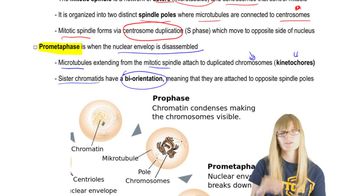
 07:03
07:03