mRNA processing occurs in the nucleus before the mature mRNA can leave for translation.
What are the three major steps of mRNA processing?
The three major steps are addition of a 5' cap, addition of a poly-A tail at the 3' end, and RNA splicing to remove introns.
What is the function of the 5' cap added to mRNA?
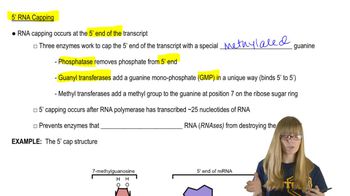
The 5' cap protects mRNA from degradation and helps distinguish it from other types of RNA.
What is the poly-A tail and what is its purpose?
The poly-A tail is a sequence of adenine bases added to the 3' end of mRNA, which stabilizes the mRNA and influences its export from the nucleus.
What is RNA splicing and what does it accomplish?
RNA splicing removes introns from pre-mRNA and joins exons together to form a continuous coding sequence.
Which enzyme complex is responsible for splicing out introns from pre-mRNA?
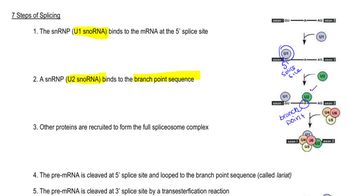
The spliceosome, composed of small nuclear RNAs and proteins, is responsible for splicing out introns.
What is the role of the C-terminal domain (CTD) of RNA polymerase II in mRNA processing?
The CTD of RNA polymerase II carries proteins involved in RNA processing and helps coordinate capping, splicing, and other modifications during transcription.
What are hnRNPs and what is their function during mRNA processing?
Heterogeneous nuclear ribonucleoproteins (hnRNPs) bind to pre-mRNA to prevent secondary structures and signal that processing is not yet complete.
At what point during transcription is the 5' cap added to the mRNA?
The 5' cap is added shortly after about 25 nucleotides of RNA have been transcribed.
How is the poly-A tail added to the mRNA?
After cleavage at a specific sequence near the 3' end, poly-A polymerase adds a stretch of adenine nucleotides without needing a template.
What are the consensus sequences involved in RNA splicing?
The main consensus sequences are GU at the 5' splice site, AG at the 3' splice site, and a branch point sequence upstream of the 3' end.
What is alternative splicing and why is it important?
Alternative splicing allows different combinations of exons to be joined, producing multiple protein variants from a single gene.
How can chromatin structure and histone modifications affect mRNA processing?
Condensed chromatin can slow transcription and processing, while histone modifications can recruit proteins that regulate splicing and processing speed.
What is RNA editing and how does it differ from other mRNA processing steps?
RNA editing involves changing the nucleotide sequence of pre-mRNA, such as by deamination, and is less common than capping, polyadenylation, or splicing.
What is the function of guide RNAs in RNA editing?
Guide RNAs direct the editing machinery to specific nucleotides in the pre-mRNA to be changed, inserted, or deleted.
 Back
Back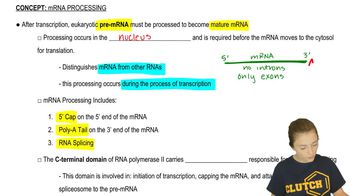
 09:55
09:55