Which type of white blood cell is characterized by being small with a large nucleus?
Lymphocytes are small white blood cells with a large nucleus, and they play a key role in the adaptive immune system.
What is a differential white blood cell count and what is its significance in host defenses?
A differential white blood cell count is a laboratory test that measures the relative proportions of different types of white blood cells in the blood, helping to assess immune system activity and identify infections or immune disorders.
What is the primary function of white blood cells in the human body's defense against pathogens?
White blood cells function to protect the body against pathogens by engulfing and destroying them (phagocytosis), producing antibodies, and coordinating immune responses.
What role do chemical barriers play in the body's first line of defense against pathogens?
Chemical barriers, such as those found on the skin, in the mouth, nose, and gut, can target and kill infections that enter these areas. They act alongside mechanical barriers to prevent pathogen entry.
How do phagocytic cells contribute to the innate immune system?
Phagocytic cells, like macrophages, engulf and digest pathogens inside the cell. This process helps eliminate infectious agents quickly and non-specifically.
What is the function of the complement system in host defenses?
The complement system is a group of proteins that bind to pathogens and mark them for destruction. It acts similarly to antibodies but is less specific in its targeting.
How does inflammation assist in controlling infections?
Inflammation recruits various white blood cells and other cell types to the site of infection. This response helps contain and eliminate pathogens.
What triggers the activation of the adaptive immune system?
The adaptive immune system is activated following the initial response of the innate immune system to an infection. This sequential activation ensures a more targeted and effective defense.
What are the main functions of B cells and T cells in the adaptive immune system?
B cells produce antibodies that specifically target pathogens, while T cells kill infected cells or pathogens directly. Both cell types provide a highly specific immune response.
Why is the innate immune response considered less complex than the adaptive immune response?
The innate immune response relies on general mechanisms like barriers and phagocytic cells that can target many pathogens. In contrast, the adaptive immune response uses highly specific antibodies and T cells tailored to individual pathogens.
 Back
Back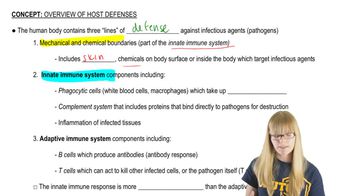
 04:28
04:28