What are the three main classes of cells based on their division characteristics, and provide an example of each?
The three main classes are non-dividing cells (e.g., nerve cells), conditionally dividing cells (e.g., liver cells), and frequently dividing cells (e.g., stem cells or skin cells).
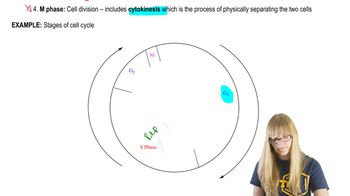
Describe the four main phases of the eukaryotic cell cycle.
The four main phases are interphase (period between divisions), gap phases (G1 and G2, which are growth periods before and after DNA replication), S phase (DNA replication), and M phase (cell division, including cytokinesis).
What is the purpose of cell cycle checkpoints, and name three key checkpoints?
Cell cycle checkpoints ensure each phase is completed correctly before the cell proceeds. The three key checkpoints are the G1 checkpoint (checks for proper growth), G2 checkpoint (checks for growth and DNA replication accuracy), and the spindle assembly checkpoint (ensures proper chromosome alignment for division).
Why is cell cycle control important, and what can happen if it is disrupted?
Cell cycle control is crucial for accurate cell division. Disruption can lead to severe consequences such as cancer or cell death.
How does the mitotic index help in understanding cell division rates among different cell types?
The mitotic index measures the percentage of cells undergoing mitosis at a given time, indicating how frequently cells in a population are dividing.
Why is the cell cycle often depicted as a circle, and what does this representation emphasize?
The cell cycle is depicted as a circle to emphasize its repetitive nature, showing that cells continuously go through growth, replication, and division phases.
What are the three main classes of cells based on their division characteristics, and give an example of each?
The three main classes are non-dividing cells (e.g., nerve cells), conditionally dividing cells (e.g., liver cells), and frequently dividing cells (e.g., stem cells or skin cells).
What are the four main phases of the eukaryotic cell cycle?
The four main phases are interphase, gap phases (G1 and G2), S phase (DNA replication), and M phase (cell division, including cytokinesis).
What is the purpose of cell cycle checkpoints, and name three key checkpoints?
Cell cycle checkpoints ensure each phase is completed correctly before the cell proceeds. The three key checkpoints are the G1 checkpoint, G2 checkpoint, and spindle assembly checkpoint.
How does the mitotic index help in understanding cell division rates among different cell types?
The mitotic index measures the percentage of cells undergoing mitosis at a given time, indicating how frequently cells in a population are dividing.
What phase precedes both mitosis and meiosis in the cell cycle?
Interphase precedes both mitosis and meiosis in the cell cycle.
What is the longest phase of the cell cycle?
Interphase is the longest phase of the cell cycle.
What is the G0 phase of the cell cycle?
The G0 phase is a resting state where cells are not actively dividing and have exited the cell cycle.
What is the time between cell divisions called?
The time between cell divisions is called interphase.
What is the period of the cell cycle between cell divisions?
The period between cell divisions is called interphase.
Which is the longest phase in the cell cycle?
Interphase is the longest phase in the cell cycle.
Name the main events of the cell cycle.
The main events of the cell cycle are interphase (including G1, S, and G2 phases) and M phase (mitosis and cytokinesis).
What is the G0 phase of the cell cycle?
The G0 phase is a non-dividing state where cells exit the cell cycle and do not prepare for division.
Describe the G0 phase of the cell cycle.
The G0 phase is a resting phase where cells are not actively progressing through the cell cycle.
What is the correct order of the cell cycle?
The correct order of the cell cycle is G1 phase, S phase, G2 phase, and M phase.
List the phases of the cell cycle in the correct order.
The phases in order are G1, S, G2, and M phase.
In the cell cycle, what includes G1, S, and G2?
G1, S, and G2 phases are all part of interphase.
What is the G0 phase of the cell cycle?
The G0 phase is a state where cells are not dividing and have exited the active cell cycle.
What is the longest stage of the cell cycle?
Interphase is the longest stage of the cell cycle.
Which phase of the cell cycle is the longest?
Interphase is the longest phase of the cell cycle.
What is the order of the cell cycle?
The order is G1 phase, S phase, G2 phase, and M phase.
Which cell cycle phase is the longest?
Interphase is the longest phase of the cell cycle.
What does the process of cell division result in?
Cell division results in the formation of two daughter cells.
What occurs during the G2 phase of the cell cycle?
During G2, the cell continues to grow and prepares for mitosis, checking for DNA replication errors.
What is the end result of the cell cycle?
The end result of the cell cycle is two genetically identical daughter cells.
What is the correct order of the cell cycle?
The correct order is G1, S, G2, and M phase.
What must occur before mitosis takes place?
DNA replication must occur before mitosis takes place.
Which part of the cell cycle takes the longest?
Interphase takes the longest in the cell cycle.
What is the longest phase of the cell cycle?
Interphase is the longest phase of the cell cycle.
What is the longest phase of the cell cycle?
Interphase is the longest phase of the cell cycle.
Which phase of the cell cycle is the shortest?
The M phase (mitosis and cytokinesis) is the shortest phase of the cell cycle.
Which is not a phase of the cell cycle?
G0 is not a phase of the active cell cycle; it is a resting state outside the cycle.
Which phase of the cell cycle is the longest?
Interphase is the longest phase of the cell cycle.
Which is the longest phase of the cell cycle?
Interphase is the longest phase of the cell cycle.