Pearson+ LogoPearson+ Logo

Overview of Tissue Structures quiz #1 Flashcards

Back
Overview of Tissue Structures quiz #1
Control buttons has been changed to "navigation" mode.
1/27
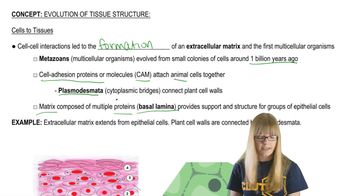
  • How did cells evolve into tissues in multicellular organisms, and what structures facilitate cell connectivity in animals and plants?

    Cells evolved into tissues through interactions and the formation of an extracellular matrix. In animals, cell adhesion molecules (CAMs) connect cells, while in plants, plasmodesmata form cytoplasmic bridges between cell walls, facilitating connectivity.
  • What are the three main types of plant tissues and their primary functions?

    The three main types of plant tissues are ground tissue (metabolism), dermal tissue (protection and nutrient absorption), and vascular tissue (transport of water and nutrients).
  • List the five main types of animal tissues and briefly describe the function of each.

    The five main types of animal tissues are: epithelial (protective covering), connective (mechanical support), blood (oxygen transport), nervous (signal transmission), and muscle (movement).
  • How does the development of multicellular organisms from a single cell involve early tissue differentiation, and what role do spatial cues play?

    Multicellular organisms develop from a single zygote, which differentiates early into various tissues and organs. Spatial cues, such as the placement of the mouth and anus, guide this process and influence the organism's body plan.
  • What are patterning genes, and how do they influence tissue and organ development in multicellular organisms?

    Patterning genes are conserved transcription factors that control the timing and formation of specific tissues and structures by regulating gene expression, guiding the development of complex organs and body symmetry.
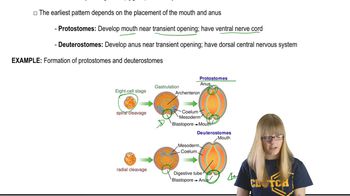
  • Explain the difference between protostomes and deuterostomes in terms of early embryonic development.

    In protostomes, the mouth develops near the initial embryonic opening, while in deuterostomes, the anus forms near this opening. This distinction affects the overall body plan and nervous system organization.
  • What structures connect animal and plant cells to form tissues, and how do they differ between these kingdoms?

    Animal cells are connected by cell adhesion molecules (CAMs) and the extracellular matrix, while plant cells are connected by plasmodesmata, which are cytoplasmic bridges between cell walls.
  • Name the three main types of plant tissues and state the primary function of each.

    Ground tissue is responsible for metabolism, dermal tissue provides protection and nutrient absorption, and vascular tissue transports water and nutrients.
  • How do patterning genes influence the development of tissues and organs in multicellular organisms?

    Patterning genes are conserved transcription factors that regulate gene expression, controlling the timing and location of tissue and organ formation during development.
  • What is the key difference between protostomes and deuterostomes in early embryonic development?

    In protostomes, the mouth develops near the initial embryonic opening, while in deuterostomes, the anus forms near this opening, influencing the organism's body plan.
  • What is another name for a nerve cell?

    A nerve cell is also called a neuron.
  • Where is the nucleus of a neuron located?

    The nucleus of a neuron is found in its cell body.
  • What are the cell fragments involved in blood clotting called?

    The cell fragments involved in clotting are called platelets.
  • Which layer of the epidermis is responsible for cell division and is the deepest?

    The deepest layer of the epidermis responsible for cell division is the basal layer.
  • Where are the cell bodies of sensory neurons located?

    The cell bodies of sensory neurons are located in the dorsal root ganglia.
  • What is another name for a red blood cell?

    A red blood cell is also called an erythrocyte.
  • What is the term for a red blood cell?

    A red blood cell is called an erythrocyte.
  • Which term best identifies a muscle cell?

    A muscle cell is best identified as a myocyte.
  • From what type of cell are platelets formed?

    Platelets are formed from megakaryocytes.
  • What is a mature bone cell called?

    A mature bone cell is called an osteocyte.
  • In what kinds of organisms is cell specialization a characteristic?

    Cell specialization is a characteristic of multicellular organisms.
  • What is the function of a red blood cell?

    The function of a red blood cell is to transport oxygen throughout the body.
  • What is a Schwann cell?

    A Schwann cell is a type of glial cell in the nervous system that forms the myelin sheath around peripheral nerve fibers.
  • Which cell is not found in the gastric pits?

    Cells not involved in secretion or lining of the stomach, such as neurons or muscle cells, are not found in the gastric pits.
  • What is another term for a fat cell?

    Another term for a fat cell is adipocyte.
  • What is the role of patterning genes in tissue development?

    Patterning genes are transcription factors that control the timing and formation of specific tissues and structures during development by regulating gene expression.
  • What are the main types of animal tissues and their functions?

    The main types of animal tissues are epithelial (protection), connective (support), blood (oxygen transport), nervous (signal transmission), and muscle (movement).