In which part of a cell is DNA coiled into chromosomes?
DNA is coiled into chromosomes in the cell's nucleus.
Where is chromatin found within a cell?
Chromatin is found in the nucleus of a cell.
How are DNA molecules stored and organized within the nucleus?
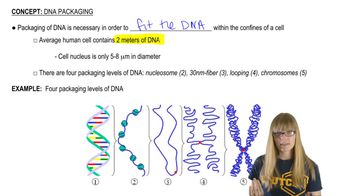
DNA molecules are stored in the nucleus by being wrapped around histone proteins to form nucleosomes, which are further organized into chromatin fibers and then condensed into chromosomes.
Where in the cell are chromosomes located?
Chromosomes are located in the nucleus of the cell.
Describe the basic structure and function of chromatin.
Chromatin is composed of DNA, histone proteins, and associated RNA, and its main function is to package DNA into a more compact, organized structure within the nucleus.
What are the main levels of DNA packaging in eukaryotic cells?
The main levels of DNA packaging are: DNA wraps around histone proteins to form nucleosomes, nucleosomes are organized into chromatin fibers, chromatin fibers are looped and further condensed, and finally, these structures form chromosomes.
What role does the H1 histone protein play in DNA packaging?
The H1 histone acts as a linker protein, connecting adjacent nucleosomes and facilitating the formation of the 30 nanometer chromatin fiber. It is essential for the higher-order structure of chromatin.
How do non-histone proteins contribute to DNA looping during packaging?
Non-histone proteins form a scaffold that attaches to DNA, maintaining large looped structures containing tens of thousands of base pairs. These loops further condense DNA beyond the chromatin fiber stage.
What is the main difference between interphase and metaphase chromosomes?
Interphase chromosomes are less condensed and not visible under a microscope, while metaphase chromosomes are highly condensed and can be seen during cell division. This difference in compaction aids chromosome movement during mitosis or meiosis.
What is a karyotype and what does it reveal about human chromosomes?
A karyotype is an ordered display of all the chromosomes in an organism, showing homologous pairs in diploid species like humans. Humans have 23 unique chromosomes, totaling 46 when paired, except for the male Y chromosome which lacks a homologous partner.
 Back
Back
 02:45
02:45