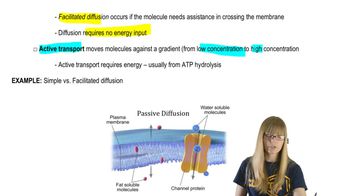
An active transport process is one that uses energy, such as ATP-powered pumps, to move molecules against their concentration gradient.
Give an example of active transport.
An example of active transport is the ATP-powered pump moving ions across the cell membrane.
What is a form of active transport?
A form of active transport is the use of ATP-powered pumps to move molecules across the membrane.
What is primary active transport?
Primary active transport is when energy from ATP is used directly to move molecules across the membrane against their gradient.
What is the main difference between diffusion and facilitated diffusion?
Diffusion occurs without assistance, while facilitated diffusion requires membrane proteins to help molecules cross.
What is an example of active transport?
An example of active transport is the ATP-powered pump moving ions across the cell membrane.
What type of energy is needed for active transport?
ATP is the type of energy needed for active transport.
What molecule is involved in active transport?
ATP is involved in active transport.
What does active transport require?
Active transport requires energy, usually from ATP.
What are the two main types of active transport?
The two main types are primary active transport (using ATP directly) and secondary active transport (using energy from an existing gradient).
What are two methods of active transport?
Two methods are primary active transport and secondary active transport.
What are the 2 major types of active transport?
The two major types are primary active transport and secondary active transport.
What is an example of an active transport?
An example is the ATP-powered pump moving ions across the cell membrane.
What is an example of active transport in a cell?
An example is the ATP-powered pump moving ions across the cell membrane.
What does active transport require?
Active transport requires energy, typically from ATP.
What is secondary active transport?
Secondary active transport uses energy from an existing gradient to move molecules across the membrane.
What does not require energy from the cell?
Passive transport, including simple and facilitated diffusion, does not require energy from the cell.
How are simple diffusion and facilitated diffusion different?
Simple diffusion does not require assistance, while facilitated diffusion uses membrane proteins to help molecules cross.
How are diffusion and facilitated diffusion different?
Diffusion occurs without assistance, while facilitated diffusion requires membrane proteins.
How is active transport similar to facilitated diffusion?
Both use membrane proteins to move molecules across the membrane.
How do active and passive transport differ?
Active transport requires energy and moves molecules against their gradient; passive transport does not require energy and moves molecules down their gradient.
How is facilitated diffusion different from active transport?
Facilitated diffusion does not require energy and moves molecules down their gradient; active transport requires energy and moves molecules against their gradient.
How do endocytosis and exocytosis differ from diffusion?
Endocytosis and exocytosis involve bulk movement of materials into or out of the cell, while diffusion involves movement of individual molecules down their gradient.
How is the cell membrane selectively permeable?
The cell membrane allows only certain molecules to pass based on size, charge, and polarity, while excluding others.
How is facilitated diffusion different from active transport?
Facilitated diffusion moves molecules down their gradient without energy; active transport moves molecules against their gradient using energy.
How do facilitated diffusion and active transport differ?
Facilitated diffusion does not require energy and moves molecules down their gradient; active transport requires energy and moves molecules against their gradient.
How is facilitated diffusion similar to simple diffusion?
Both move molecules down their concentration gradient without energy input.
How does pyruvate enter mitochondria?
Pyruvate enters mitochondria via facilitated diffusion using a membrane protein.
What are three types of active transport?
Three types are ATP-powered pumps, primary active transport, and secondary active transport.
What are the 3 types of active transport?
The three types are ATP-powered pumps, primary active transport, and secondary active transport.
What are the two major types of active transport?
The two major types are primary active transport and secondary active transport.
How is active transport different from diffusion?
Active transport requires energy and moves molecules against their gradient; diffusion does not require energy and moves molecules down their gradient.
When would a cell have to use active transport?
A cell uses active transport when it needs to move molecules against their concentration gradient.
Why is the cell membrane selectively permeable?
The cell membrane is selectively permeable to regulate the entry and exit of substances, maintaining cellular homeostasis.
 Back
Back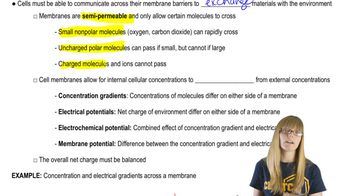
 03:37
03:37