What other type of cell has a cell wall besides prokaryotes?
Plant and fungal cells, which are eukaryotic, also have a cell wall.
How does binary fission differ from mitosis?
Binary fission is the process by which prokaryotic cells divide, involving simple splitting of the cell and duplication of circular DNA, while mitosis is the process in eukaryotic cells involving complex steps and division of linear chromosomes within a nucleus.
How is a eukaryotic cell different from a prokaryotic cell?
Eukaryotic cells have a membrane-bound nucleus, internal membranes, and a cytoskeletal system, while prokaryotic cells lack these features.
What cell part is not found in all cells?
A nucleus is not found in all cells; only eukaryotic cells have a nucleus.
Chloroplasts and cell walls are found only in which types of cells?
Chloroplasts and cell walls are found only in plant cells and some other eukaryotic cells.
Which kingdoms have cell walls?
The kingdoms that have cell walls include plants, fungi, and most prokaryotes (bacteria and archaea).
Which cell structures are seen in both prokaryotic and eukaryotic cells?
Both prokaryotic and eukaryotic cells have a plasma membrane.
Which microbes have a true nucleus?
Microbes that are eukaryotic, such as protists and fungi, have a true nucleus.
Which type of cell has membrane-bound organelles?
Eukaryotic cells have membrane-bound organelles.
Which kingdoms do not have a nucleus?
The kingdoms Bacteria and Archaea do not have a nucleus.
Explain how mitosis differs from binary fission.
Mitosis is a complex process in eukaryotic cells involving division of linear chromosomes within a nucleus, while binary fission is a simpler process in prokaryotic cells involving division of circular DNA without a nucleus.
 Back
Back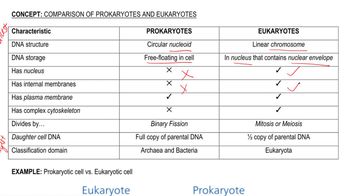
 03:04
03:04