Pearson+ LogoPearson+ Logo

Prokaryotic Cell Architecture quiz #1 Flashcards

Back
Prokaryotic Cell Architecture quiz #1
Control buttons has been changed to "navigation" mode.
1/40
  • What are the two main domains of prokaryotic cells, and how do they differ in their environmental adaptations?

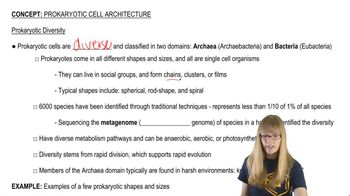
    The two main domains of prokaryotic cells are Bacteria and Archaea. Archaea often live in extreme environments (extremophiles), such as hot springs or deep-sea vents, while Bacteria are found in a wide range of habitats.
  • How has metagenomics expanded our understanding of prokaryotic diversity compared to traditional culturing methods?

    Metagenomics sequences DNA from environmental samples, revealing thousands of previously unidentified prokaryotic species, whereas traditional culturing methods could only identify a small fraction that could be grown in the lab.
  • What are the key structural features that distinguish prokaryotic cells from eukaryotic cells?

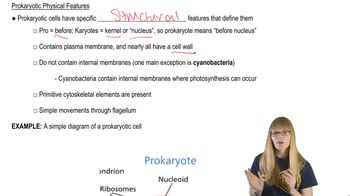
    Prokaryotic cells lack a nucleus and internal membrane-bound organelles, have a plasma membrane, most have a cell wall, and contain primitive cytoskeletal elements. Their DNA is stored in a nucleoid region.
  • Describe the organization and replication of genetic material in prokaryotic cells.

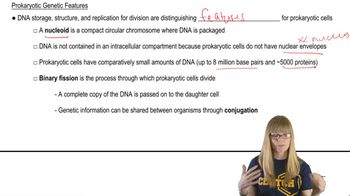
    Prokaryotic cells store their DNA as a circular chromosome in the nucleoid region. They replicate their DNA through binary fission, passing a complete copy to each daughter cell, and can exchange genes via conjugation.
  • How does gene expression in prokaryotic cells differ from that in eukaryotic cells?

    Gene expression in prokaryotic cells occurs in a single compartment, with simple transcription and translation using smaller, less complex ribosomes, unlike the compartmentalized and more complex processes in eukaryotes.
  • What are the two main domains of prokaryotic cells, and how do they differ in their environmental adaptations?

    The two main domains are Bacteria and Archaea. Archaea often live in extreme environments, while Bacteria are found in a wide range of habitats.
  • How has metagenomics expanded our understanding of prokaryotic diversity compared to traditional culturing methods?

    Metagenomics sequences DNA from environmental samples, revealing thousands of previously unidentified prokaryotic species. Traditional culturing methods could only identify a small fraction that could be grown in the lab.
  • What are the key structural features that distinguish prokaryotic cells from eukaryotic cells?

    Prokaryotic cells lack a nucleus and internal membrane-bound organelles, have a plasma membrane, most have a cell wall, and contain primitive cytoskeletal elements. Their DNA is stored in a nucleoid region.
  • Describe the organization and replication of genetic material in prokaryotic cells.

    Prokaryotic cells store their DNA as a circular chromosome in the nucleoid region. They replicate their DNA through binary fission, passing a complete copy to each daughter cell, and can exchange genes via conjugation.
  • How does gene expression in prokaryotic cells differ from that in eukaryotic cells?

    Gene expression in prokaryotic cells occurs in a single compartment, with simple transcription and translation using smaller, less complex ribosomes. In contrast, eukaryotic gene expression is compartmentalized and more complex.
  • Where is DNA found in a prokaryotic cell?

    DNA in a prokaryotic cell is found in the nucleoid region, which is not membrane-bound.
  • What is the function of lipopolysaccharide in prokaryotic cells?

    Lipopolysaccharide is an important component of the cell wall in Gram-negative bacteria, providing structural integrity and protection.
  • Do prokaryotic cells have ribosomes?

    Yes, prokaryotic cells have ribosomes, but they are smaller and less complex than those in eukaryotic cells.
  • What is an example of a prokaryotic cell?

    Examples of prokaryotic cells include bacteria and archaea.
  • What is the function of plasmids in prokaryotic cells?

    Plasmids in prokaryotic cells carry extra genetic information, often including genes for antibiotic resistance or other specialized functions.
  • Which kingdom has peptidoglycan in its cell wall?

    The kingdom Bacteria has peptidoglycan in its cell wall.
  • What are the main features of a prokaryotic cell?

    Main features of prokaryotic cells include lack of a nucleus, absence of internal membrane-bound organelles, presence of a plasma membrane, most have a cell wall, and DNA stored in a nucleoid.
  • Which cell structure is unique to prokaryotes?

    The nucleoid, where DNA is stored without a surrounding membrane, is unique to prokaryotes.
  • What protects a prokaryotic cell from injury?

    The cell wall protects a prokaryotic cell from injury and provides structural support.
  • What is the purpose of the cell wall in prokaryotic cells?

    The cell wall provides structural support and protection to prokaryotic cells.
  • What is the fungi cell wall made of?

    The fungi cell wall is made of chitin.
  • What is the bacteria cell wall made of?

    The bacteria cell wall is made of peptidoglycan.
  • What types of cells have cell walls?

    Cells with cell walls include bacteria, archaea, fungi, and plant cells.
  • What is the cell wall made of in bacteria?

    The cell wall in bacteria is made of peptidoglycan.
  • What type of cells have no nucleus?

    Prokaryotic cells, such as bacteria and archaea, have no nucleus.
  • What does penicillin target in the bacterial cell?

    Penicillin targets the synthesis of peptidoglycan in the bacterial cell wall.
  • What type of cell does not have membrane-bound organelles?

    Prokaryotic cells do not have membrane-bound organelles.
  • How do the cell walls of archaea and bacteria differ?

    Bacterial cell walls contain peptidoglycan, while archaeal cell walls do not; archaea have different cell wall components.
  • What is the control center of the bacterial cell?

    The nucleoid region, containing the cell's DNA, acts as the control center of the bacterial cell.
  • What organelle is missing from E. coli?

    E. coli, like all prokaryotes, lacks a nucleus and other membrane-bound organelles.
  • What does the capsule do in a prokaryotic cell?

    The capsule provides protection against desiccation and helps evade the host immune system.
  • What is a prokaryotic cell?

    A prokaryotic cell is a single-celled organism lacking a nucleus and internal membrane-bound organelles, with DNA stored in a nucleoid.
  • What is the size of the bacterial ribosome?

    Bacterial ribosomes are 70S in size, smaller than eukaryotic ribosomes.
  • What is the mass of a bacterial cell?

    The mass of a typical bacterial cell is on the order of 1 picogram (1 x 10^-12 grams).
  • What is cell division in prokaryotes called?

    Cell division in prokaryotes is called binary fission.
  • What is the function of pili in bacterial cells?

    Pili are involved in attachment to surfaces and in genetic exchange through conjugation.
  • What is the function of the plasma membrane in prokaryotic cells?

    The plasma membrane controls the movement of substances in and out of the cell and maintains cellular integrity.
  • What is the function of the flagellum in prokaryotic cells?

    The flagellum enables motility, allowing prokaryotic cells to move.
  • What is the genetic material of prokaryotic cells?

    Prokaryotic cells have a single, circular chromosome located in the nucleoid region.
  • How do prokaryotic cells replicate their DNA?

    Prokaryotic cells replicate their DNA through binary fission, producing two identical daughter cells.