Where in the cell must the signal recognition particle (SRP) receptor be located to facilitate protein sorting?
The SRP receptor must be located in the membrane of the endoplasmic reticulum (ER), where it recognizes and binds the SRP-protein complex to initiate translocation of proteins into the ER.
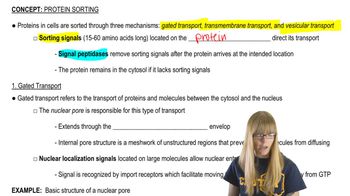
What role do signal peptidases play in protein sorting within the cell?
Signal peptidases remove sorting signals from proteins once they reach their correct cellular location. This ensures the protein remains in its designated organelle or region.
How do nuclear localization signals facilitate gated transport?
Nuclear localization signals are recognized by import receptors that help proteins move through the nuclear pore complex. This process requires energy from GTP to occur.
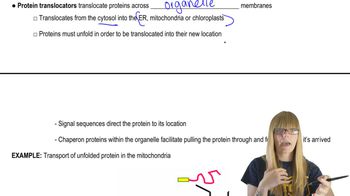
Why must proteins unfold before transmembrane transport into organelles like mitochondria or the ER?
Proteins must unfold to pass through protein translocators embedded in organelle membranes. After translocation, chaperone proteins refold them inside the organelle.
What is the function of chaperone proteins during transmembrane transport?
Chaperone proteins assist in refolding proteins that have been translocated into organelles. This ensures the proteins regain their functional structure after crossing the membrane.
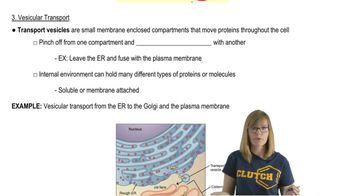
How do transport vesicles move proteins from the ER to the plasma membrane?
Transport vesicles bud off from the ER, carrying proteins, and then fuse with the plasma membrane to deliver their cargo. This process can also involve passage through the Golgi apparatus.
What determines the specific destination of a protein within the cell?
Short amino acid sorting signals on the protein direct it to its correct cellular region or organelle. These signals are recognized by cellular machinery responsible for transport.
How does the environment inside a transport vesicle differ from the cytoplasm?
The environment inside a transport vesicle can have different concentrations of proteins or molecules compared to the cytoplasm. Each vesicle may also contain unique contents depending on its destination.
What happens to proteins that lack any sorting signals?
Proteins without sorting signals remain in the cytosol. They are not directed to any specific organelle or compartment.
What structural feature of the nuclear pore complex helps regulate protein entry into the nucleus?
The nuclear pore complex contains unstructured regions that block large or unauthorized molecules from passing through. Only proteins with nuclear localization signals can be transported into the nucleus.