What molecule stores genetic information in a cell?
DNA stores genetic information in a cell.
Which important polymer is located in the nucleus of eukaryotic cells?
DNA is the important polymer located in the nucleus of eukaryotic cells.
Where in the cell is DNA typically found?
DNA is typically found in the nucleus of eukaryotic cells.
What are the building blocks of DNA and what are their types?
The building blocks of DNA are nucleotides, which include four bases: Adenine (A), Cytosine (C), Guanine (G), and Thymine (T). These bases are categorized into purines (A and G) and pyrimidines (C and T).
What type of chemical bond connects the sugar and phosphate groups in the DNA backbone?
Phosphodiester bonds connect the sugar and phosphate groups in the DNA backbone. These bonds provide structural stability and directionality to the DNA strand.
How does the polarity of the DNA backbone affect its interaction with water?
The charged phosphate groups make the DNA backbone polar. This polarity allows DNA to interact easily with water molecules.
What structural feature distinguishes purines from pyrimidines in DNA?
Purines have two carbon rings, while pyrimidines have one carbon ring. This difference affects how they pair with each other in the DNA double helix.
What is meant by the term 'antiparallel' when describing DNA strands?
Antiparallel means the two DNA strands run in opposite directions, with one strand's 5' end aligned with the other's 3' end. This orientation is essential for complementary base pairing.
How many base pairs are found in one helical turn of the DNA double helix?
There are 10 base pairs in one helical turn of the DNA double helix. This adds 3.4 nanometers to the length of the DNA.
What are the three types of DNA double helices and how do they differ?
The three types are B-DNA (most common), A-DNA (rare, right-handed, shorter), and Z-DNA (rare, left-handed). Each type has distinct structural characteristics and helical handedness.
 Back
Back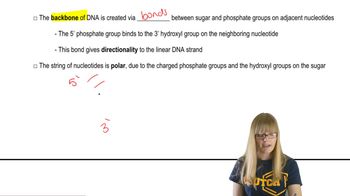
 08:23
08:23