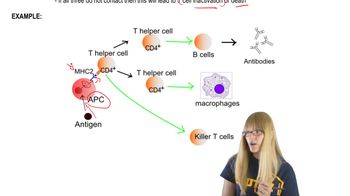
What components are required for T cell activation in the adaptive immune system?
T cell activation requires interaction with antigens presented by antigen presenting cells (APCs) via MHC molecules, co-stimulatory molecules, and cell adhesion molecules.
Which cells are responsible for cell-mediated immunity?
T cells, specifically cytotoxic T cells, are responsible for cell-mediated immunity by directly killing infected cells.
What initiates the activation of T cells?
T cell activation is initiated when T cells interact with antigens presented by antigen presenting cells (APCs) through MHC molecules, along with co-stimulatory and cell adhesion signals.
What process do T cell receptors undergo to achieve diversity in antigen recognition?
T cell receptors undergo VDJ recombination, which rearranges gene segments to create a diverse repertoire of receptors. This allows T cells to recognize a wide variety of antigens.
Where do naive T cells first encounter antigens for activation?
Naive T cells encounter antigens for activation in the thymus, an organ located in the neck and throat region. In the thymus, they interact with antigen presenting cells displaying antigens.
What happens to a T cell if it fails to interact with all three required components during activation?
If a T cell fails to interact with the antigen, co-stimulatory molecules, and cell adhesion molecules, it becomes inactivated or dies. This mechanism prevents inappropriate T cell activation.
Which accessory molecule is found on cytotoxic T cells and what does it bind?
The accessory molecule CD8 is found on cytotoxic T cells. It binds to class I MHC molecules on antigen presenting cells.
How do cytotoxic T cells induce death in infected cells?
Cytotoxic T cells can release perforin to form pores in the target cell or use FAS ligand to trigger apoptosis. Both mechanisms result in the destruction of the infected cell and pathogen.
What is the primary function of regulatory T cells in the immune response?
Regulatory T cells suppress the activity of other T cells to prevent overactive immune responses. They also help prevent autoimmunity by inhibiting self-reactive T cells.
Which accessory molecule is present on helper and regulatory T cells, and which MHC class does it interact with?
Helper and regulatory T cells express the CD4 accessory molecule. CD4 binds to class II MHC molecules on antigen presenting cells.