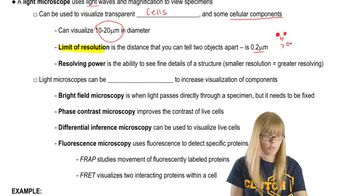
During microscopic observation with a light microscope, what color does the cell nucleus typically stain?
During microscopic observation, the cell nucleus typically stains a dark blue or purple color due to the use of basic dyes like hematoxylin, which bind to the acidic components of the nucleus such as DNA.
What is the main advantage of using a light microscope in cell biology?
The main advantage is its ability to visualize transparent cells and cellular compartments. This allows researchers to study cell structure and organization more effectively than with the naked eye.
What does the term 'limit of resolution' refer to in microscopy?
It refers to the minimum distance between two objects at which they can still be distinguished as separate entities. For light microscopes, this distance must be greater than 0.2 microns.
How does resolving power relate to the limit of resolution in a light microscope?
Resolving power is the ability to see fine details of a structure, and it increases as the limit of resolution decreases. A smaller limit of resolution means greater resolving power.
Why are fixed specimens required for bright field microscopy?
Bright field microscopy requires fixed specimens because the technique involves passing light directly through the sample. Live cells cannot be used as they need to be dead and attached to a slide for this method.
Which microscopy techniques are especially useful for visualizing live cells?
Phase contrast microscopy and differential interference microscopy are especially useful for visualizing live cells. These techniques enhance contrast without the need for fixing the specimens.
What is the primary function of fluorescent microscopy in cell biology?
Fluorescent microscopy uses fluorescence to detect specific proteins or organelles within cells. It allows researchers to study the location and behavior of these cellular components.
What does FRAB technique study in fluorescent microscopy?
FRAB is used to study the movement of proteins within cells. It helps researchers understand protein dynamics and interactions.
What does FRET technique visualize in fluorescent microscopy?
FRET visualizes two interacting proteins within a cell. It is useful for studying protein-protein interactions in real time.
Why might a researcher choose a method other than light microscopy for studying fine structural details?
A researcher might choose another method because the light microscope cannot resolve very fine structural details. More advanced forms of microscopy are needed for higher resolution imaging.