Pearson+ LogoPearson+ Logo
Back

The Lipid Bilayer quiz #1

Control buttons has been changed to "navigation" mode.
1/40
  • What are the main types of lipids found in the lipid bilayer, and what are their primary functions?

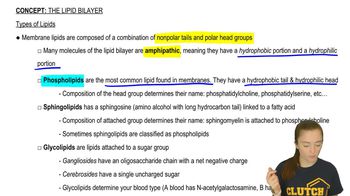
    The main types of lipids in the lipid bilayer are phospholipids (form the foundation and provide structure), sphingolipids (contribute to membrane stability and protection), glycolipids (involved in cell recognition), and sterols like cholesterol (regulate membrane fluidity and stability).
  • How does the lipid bilayer maintain its asymmetry, and what roles do flipases and scramblases play in this process?

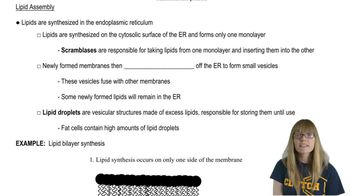
    The lipid bilayer is asymmetric, with different lipid compositions on each side. Flipases are specific enzymes that move certain lipids to one side of the bilayer, helping maintain this asymmetry. Scramblases, in contrast, randomly transfer lipids between layers during membrane synthesis, creating a more even distribution before flipases establish the final asymmetry.
  • What structural feature makes phospholipids the primary building blocks of the lipid bilayer?

    Phospholipids have amphipathic properties, with hydrophobic tails and hydrophilic heads, allowing them to form the bilayer structure that separates the cell from its environment.
  • How do sphingolipids contribute to the function of the lipid bilayer?

    Sphingolipids help maintain membrane stability and protect the cell from environmental factors by reinforcing the bilayer structure.
  • What is the main role of glycolipids in the cell membrane?

    Glycolipids are involved in cell recognition, acting as markers that help cells identify each other, such as determining blood cell types.
  • How does cholesterol affect the fluidity of the lipid bilayer?

    Cholesterol regulates membrane fluidity by preventing the bilayer from becoming too rigid in cold temperatures or too fluid in warm temperatures, maintaining an optimal state.
  • What are the three main types of lipid movement within the bilayer, and which is the rarest?

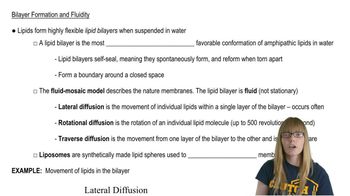
    The three types are lateral diffusion, rotational diffusion, and transverse (flip-flop) diffusion, with transverse diffusion being the rarest.
  • How does the saturation of lipid tails influence membrane fluidity?

    Saturated tails (no double bonds) make the membrane more rigid, while unsaturated tails (with double bonds) introduce kinks that increase fluidity.
  • What is the difference between flipases and scramblases in maintaining bilayer asymmetry?

    Flipases specifically move certain lipids to one side of the bilayer to establish asymmetry, while scramblases randomly transfer lipids between layers during membrane synthesis to initially mix them.
  • Where does lipid synthesis primarily occur in the cell, and how are new bilayers formed?

    Lipid synthesis occurs on the cytosolic surface of the endoplasmic reticulum (ER), where scramblases help distribute lipids to both sides to form a bilayer before vesicles transport them to their destinations.
  • What is the role of cholesterol in a phospholipid bilayer?

    Cholesterol helps regulate membrane fluidity, preventing the bilayer from becoming too rigid or too fluid, and stabilizes the membrane under varying temperatures.
  • Which structure is most responsible for maintaining cell homeostasis?

    The cell membrane (lipid bilayer) is most responsible for maintaining cell homeostasis by controlling what enters and leaves the cell.
  • Why do phospholipids form a bilayer?

    Phospholipids form a bilayer because their amphipathic nature—with hydrophilic heads and hydrophobic tails—causes them to arrange so that the hydrophobic tails are shielded from water, while the hydrophilic heads face the aqueous environment.
  • What is the primary function of the cell membrane?

    The primary function of the cell membrane is to act as a selective barrier, controlling the movement of substances in and out of the cell and protecting cellular contents.
  • What are carbohydrates used for within the cell membrane?

    Carbohydrates in the cell membrane are primarily used for cell recognition and identification, often as part of glycolipids or glycoproteins.
  • Which part of a phospholipid is hydrophobic?

    The fatty acid tails of a phospholipid are hydrophobic.
  • Where can cholesterol be found within the cell membrane?

    Cholesterol is found interspersed among the phospholipids within the cell membrane.
  • What is the function of carbohydrates in the cell membrane?

    Carbohydrates function in the cell membrane as markers for cell recognition and help in cell-to-cell communication.
  • How do cationic detergents disrupt the cell membrane?

    Cationic detergents disrupt the cell membrane by interfering with the lipid bilayer, causing it to break apart and lose its integrity.
  • What do carbohydrates do in the cell membrane?

    Carbohydrates in the cell membrane serve as recognition sites for cell signaling and identification.
  • Which lipid is the main component of cell membranes?

    Phospholipids are the main component of cell membranes.
  • Which part of the phospholipid is hydrophobic?

    The hydrophobic part of a phospholipid is its fatty acid tail.
  • What part of the phospholipid is hydrophobic?

    The hydrophobic part of a phospholipid is the nonpolar fatty acid tail.
  • In a cell membrane, the phospholipid heads are:

    The phospholipid heads are hydrophilic and face the aqueous environment inside and outside the cell.
  • What part of a phospholipid is hydrophobic?

    The fatty acid tail of a phospholipid is hydrophobic.
  • Which of these is a phospholipid?

    A phospholipid is a molecule with a hydrophilic head and two hydrophobic fatty acid tails.
  • What part of a phospholipid is polar?

    The head of a phospholipid is polar and hydrophilic.
  • What is the function of cholesterol in the cell membrane?

    Cholesterol maintains membrane fluidity and stability, especially under temperature changes.
  • The head of a phospholipid is:

    The head of a phospholipid is hydrophilic and polar.
  • What is the function of carbohydrates in cell membrane?

    Carbohydrates in the cell membrane function in cell recognition and communication.
  • Where can cholesterol be found within the cell membrane?

    Cholesterol is found embedded between phospholipids in the cell membrane.
  • What is the function of carbohydrates in cell membrane?

    Carbohydrates function as recognition sites and help in cell-to-cell communication.
  • The primary structural components of the cell membrane are:

    The primary structural components are phospholipids, proteins, and cholesterol.
  • What are the three components of a phospholipid?

    A phospholipid consists of a phosphate group (head), a glycerol backbone, and two fatty acid tails.
  • A phospholipid molecule has:

    A phospholipid molecule has a hydrophilic head and two hydrophobic fatty acid tails.
  • How do cationic detergents disrupt the cell membrane?

    Cationic detergents disrupt the cell membrane by breaking apart the lipid bilayer, compromising cell integrity.
  • Where is cholesterol found in the cell membrane?

    Cholesterol is found interspersed among the phospholipids in the cell membrane.
  • What is the role of cholesterol in the cell membrane?

    Cholesterol regulates membrane fluidity and stability.
  • How are phospholipids arranged in the cell membrane?

    Phospholipids are arranged in a bilayer with hydrophilic heads facing outward and hydrophobic tails facing inward.
  • Where can cholesterol be found in the cell membrane?

    Cholesterol is located between phospholipids within the cell membrane.