What is the purpose of cholesterol in the cell membrane?
Cholesterol helps maintain the proper fluidity and stability of the cell membrane.
Why do phospholipids form a bilayer in the plasma membrane?
Phospholipids form a bilayer because their hydrophobic tails avoid water while hydrophilic heads interact with water, creating a stable barrier.
What membrane surrounds and protects the cell?
The cell membrane (plasma membrane) surrounds and protects the cell.
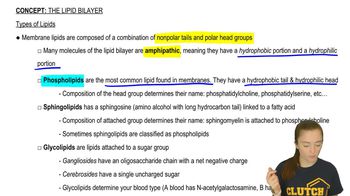
Describe the structure of a phospholipid.
A phospholipid has a hydrophilic phosphate head, a glycerol backbone, and two hydrophobic fatty acid tails.
Where is the cell membrane located in an animal cell?
The cell membrane is located at the outer boundary of an animal cell.
Why do phospholipids form a bilayer in the cell membrane?
Phospholipids form a bilayer because their hydrophobic tails avoid water, while hydrophilic heads face the aqueous environment, creating a stable barrier.
What is another name for the cell membrane?
Another name for the cell membrane is the plasma membrane.
What is the outer boundary of the cell?
The cell membrane is the outer boundary of the cell.
Is a cell membrane present in both plant and animal cells?
Yes, both plant and animal cells have a cell membrane.
What structure is composed of a phospholipid bilayer?
The cell membrane is composed of a phospholipid bilayer.
What is the function of carbohydrates in cell membrane?
Carbohydrates function in cell recognition and communication.
What are the three components of a phospholipid?
The three components are a phosphate group (head), a glycerol backbone, and two fatty acid tails.
The plasma membrane of a cell consists of:
The plasma membrane consists of phospholipids, proteins, and cholesterol.
What do carbohydrates do in the cell membrane?
Carbohydrates act as recognition sites and help in cell-to-cell communication.
Are cell membranes present in both plant and animal cells?
Yes, cell membranes are present in both plant and animal cells.
The cell membrane is selectively permeable. What does this mean?
Selectively permeable means the cell membrane allows certain substances to pass through while blocking others.
Which is a component of a phospholipid?
A component of a phospholipid is a phosphate group (head), a glycerol backbone, or a fatty acid tail.
Which cell structure is selectively permeable?
The cell membrane is selectively permeable.
What best describes the cell membrane?
The cell membrane is a selectively permeable, dynamic barrier composed of a phospholipid bilayer with embedded proteins and cholesterol.
What molecules make up the cell membrane?
The cell membrane is made up of phospholipids, proteins, cholesterol, and carbohydrates.
What strengthens the cell membrane?
Cholesterol strengthens the cell membrane by increasing its rigidity and stability.
What is the head of a phospholipid made of?
The head of a phospholipid is made of a phosphate group.
What does cholesterol do in the cell membrane?
Cholesterol regulates membrane fluidity and stability.
What are three components of a phospholipid?
A phospholipid has a phosphate group (head), a glycerol backbone, and two fatty acid tails.
What does cholesterol do in the cell membrane?
Cholesterol helps maintain the fluidity and stability of the cell membrane.
What does cholesterol do in a cell membrane?
Cholesterol modulates membrane fluidity and stability.
What does cholesterol do in the cell membrane?
Cholesterol maintains membrane fluidity and prevents it from becoming too rigid or too fluid.
What is the outer boundary of the cell?
The cell membrane is the outer boundary of the cell.
What is another name for the cell membrane?
Another name for the cell membrane is the plasma membrane.
What is the role of cholesterol in cell membranes?
Cholesterol regulates membrane fluidity and stability.
The cell membrane is what type of permeable?
The cell membrane is selectively permeable.
What organelle is made of phospholipids?
The cell membrane and other organelles like the endoplasmic reticulum and Golgi apparatus are made of phospholipids.
What is another name for the cell membrane?
Another name for the cell membrane is the plasma membrane.
What controls what enters and leaves the cell?
The cell membrane controls what enters and leaves the cell.
What is the purpose of the cell membrane?
The cell membrane serves as a selective barrier, protecting the cell and regulating the movement of substances.
What is a cell membrane made of?
A cell membrane is made of a phospholipid bilayer, proteins, cholesterol, and carbohydrates.
What does cholesterol do in the cell membrane?
Cholesterol helps maintain membrane fluidity and stability.
What is the cell membrane made of?
The cell membrane is made of phospholipids, proteins, cholesterol, and carbohydrates.
What are cell membranes made of?
Cell membranes are made of phospholipids, proteins, cholesterol, and carbohydrates.
What does the cell membrane do?
The cell membrane acts as a selective barrier, controlling the movement of substances and protecting the cell.
 Back
Back
 04:10
04:10