What is the main function of transcriptional regulators in gene expression?
Transcriptional regulators control gene expression by activating or repressing the transcription of genes through interactions with promoters, other proteins, and RNA polymerase.
How do transcriptional repressors inhibit gene expression?
Transcriptional repressors inhibit gene expression by binding to DNA and blocking transcription, often by competing with activators or interacting with other proteins to prevent RNA polymerase from transcribing the gene.
What role do coactivators and corepressors play in transcriptional regulation?
Coactivators and corepressors assist activators or repressors by interacting with RNA polymerase, altering chromatin structure, or activating other regulatory proteins to facilitate or inhibit transcription.
What is the function of the mediator complex in transcription?
The mediator complex is a large protein complex that interacts between regulatory proteins and RNA polymerase to facilitate either activation or inhibition of transcription.
What are the four common DNA binding motifs found in transcriptional regulators?
The four common DNA binding motifs are helix-turn-helix, zinc fingers, leucine zipper, and helix-loop-helix.
How does the helix-turn-helix motif interact with DNA?
In the helix-turn-helix motif, one helix makes contact with the DNA while the other helix stabilizes the interaction, allowing the protein to bind DNA.
What is the significance of the sigma subunit in prokaryotic RNA polymerase?
The sigma subunit determines which promoters RNA polymerase recognizes, allowing prokaryotic cells to control gene expression by swapping different sigma subunits.
What is the difference between general and sequence-specific transcription factors?
General transcription factors are found at every transcribed gene and bind to the core promoter, while sequence-specific factors bind only to specific DNA sequences to regulate particular genes.
Where do promoter proximal elements lie in relation to the gene, and what is their function?
Promoter proximal elements are located near the promoter site and serve as binding sites for regulatory factors that help initiate transcription.
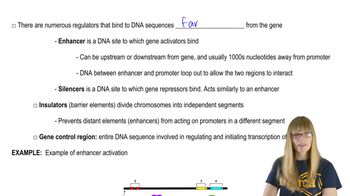
How do enhancers and silencers regulate gene expression from a distance?
Enhancers and silencers can be thousands of nucleotides away from the gene and regulate expression by looping the DNA to interact with the promoter, either activating (enhancers) or repressing (silencers) transcription.
What is the role of insulators (barrier elements) in gene regulation?
Insulators divide chromosomes into regions, preventing enhancers from activating genes in different regions and ensuring specificity in gene regulation.
What is the gene control region?
The gene control region includes all DNA elements involved in regulating a gene's transcription, such as promoters, enhancers, silencers, and insulators.
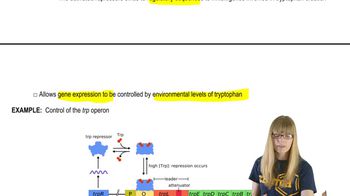
How does the tryptophan repressor regulate gene expression in prokaryotes?
When tryptophan is abundant, it binds to the tryptophan repressor, activating it to bind the operon and inhibit transcription of genes involved in tryptophan synthesis.
What happens to the lac operon in E. coli when lactose is absent?
When lactose is absent, the lac repressor binds to the operon and halts transcription, preventing the expression of genes needed for lactose metabolism.
How does the presence of lactose affect the lac operon?
When lactose is present, the lac repressor is inactivated and the cap protein binds upstream, leading to strong activation and transcription of the lac operon genes.
 Back
Back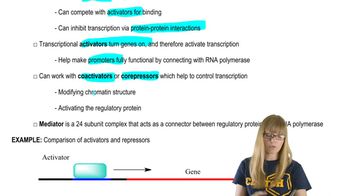
 04:14
04:14