What are the main steps of translation in eukaryotic cells, and what roles do the ribosomal subunits play during this process?
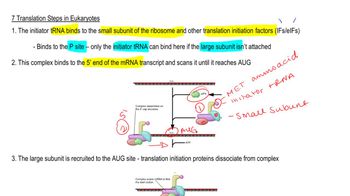
Translation in eukaryotic cells begins with the small ribosomal subunit and initiator tRNA binding to the 5' end of mRNA, scanning for the start codon (AUG). Once found, the large subunit joins to form a complete ribosome. During elongation, tRNAs bring amino acids to the ribosome, which are added to the growing polypeptide chain as the ribosome moves along the mRNA. The large subunit catalyzes peptide bond formation, while the small subunit ensures correct tRNA-mRNA pairing. Translation ends when a stop codon is reached, and release factors help release the new protein and dissociate the ribosome.
How does translation initiation differ between prokaryotic and eukaryotic cells?
In eukaryotic cells, translation initiation requires the ribosome to bind to the 5' cap of the mRNA and scan for the start codon. In prokaryotic cells, mRNAs lack a 5' cap; instead, the ribosome binds to a specific sequence called the Shine-Dalgarno sequence near the start codon. Additionally, prokaryotic ribosomes are smaller and are targeted by certain antibiotics that do not affect eukaryotic ribosomes.
What are the three main sites on the ribosome involved in translation, and what is the function of each site?
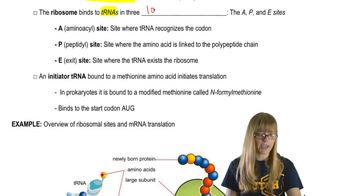
The A site is where tRNA recognizes the codon, the P site is where the amino acid is added to the polypeptide chain, and the E site is where the tRNA exits the ribosome.
During translation initiation in eukaryotes, what is the role of the small ribosomal subunit and the initiator tRNA?
The small ribosomal subunit binds to the initiator tRNA and then to the 5' end of the mRNA, scanning for the start codon (AUG) before the large subunit joins.
How does the ribosome move along the mRNA during elongation, and what happens to the tRNAs?
The ribosome moves three nucleotides (one codon) at a time along the mRNA, with tRNAs entering at the A site, moving to the P site, and exiting at the E site.
What is the function of elongation factors like EF-2 during translation?
Elongation factors such as EF-2 assist the ribosome in moving along the mRNA and help tRNAs bind to the mRNA, often using energy from GTP hydrolysis.
How is translation terminated, and what role do release factors play?
Translation ends when a stop codon is reached; release factors hydrolyze a water molecule to release the new protein and dissociate the ribosome from the mRNA.
What is the main difference in translation initiation between prokaryotic and eukaryotic cells?
Eukaryotic ribosomes bind to the 5' cap of mRNA and scan for the start codon, while prokaryotic ribosomes bind to the Shine-Dalgarno sequence near the start codon.
Why are prokaryotic ribosomes targeted by certain antibiotics but not eukaryotic ribosomes?
Prokaryotic ribosomes are slightly smaller and structurally different from eukaryotic ribosomes, allowing some antibiotics to specifically inhibit prokaryotic translation.
What are polyribosomes (polysomes), and how do they increase the efficiency of protein synthesis?
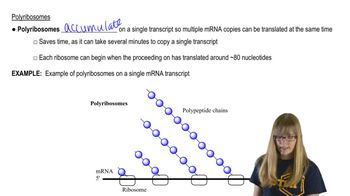
Polyribosomes are clusters of ribosomes translating a single mRNA simultaneously, allowing multiple copies of a protein to be made quickly from one mRNA transcript.
At which site of the ribosome does the initiator tRNA attach during the initiation of translation?
The initiator tRNA attaches at the P site of the ribosome during the initiation of translation.
Where in the cell does translation occur?
Translation occurs in the cytoplasm of the cell.
Which organelle is responsible for making proteins in the cell?
The ribosome is responsible for making proteins in the cell.
Where does translation take place in a eukaryotic cell?
In eukaryotic cells, translation takes place in the cytoplasm.
Which organelle is responsible for translation?
The ribosome is responsible for translation.
What is the function of a ribosome?
The function of a ribosome is to synthesize proteins by translating mRNA into a polypeptide chain.
Which organelle is the site of translation?
The ribosome is the site of translation.
What is the main function of the ribosome in the cell?
The main function of the ribosome is to assemble amino acids into proteins according to the sequence of codons in mRNA.
Which organelle is responsible for synthesizing proteins?
The ribosome is responsible for synthesizing proteins.
Which organelle is responsible for protein synthesis?
The ribosome is responsible for protein synthesis.
Which organelle is responsible for making proteins?
The ribosome is responsible for making proteins.
Which organelle is the site of protein synthesis?
The ribosome is the site of protein synthesis.
Which organelle is involved in translation?
The ribosome is involved in translation.
Which organelle builds proteins in the cell?
The ribosome builds proteins in the cell.
What is the purpose of the ribosome?
The purpose of the ribosome is to translate mRNA into a polypeptide chain, forming proteins.
What happens when a ribosome reaches a stop codon during translation?
When a ribosome reaches a stop codon, release factors bind, hydrolyze a water molecule, and release the newly formed protein and the ribosome from the mRNA.
What organelle synthesizes proteins in the cell?
The ribosome synthesizes proteins in the cell.
What is the main function of a ribosome?
The main function of a ribosome is to translate mRNA into a polypeptide chain, creating proteins.
What organelle is the site of protein synthesis in the cell?
The ribosome is the site of protein synthesis in the cell.
What organelle produces proteins in the cell?
The ribosome produces proteins in the cell.
What is the function of ribosomes in an animal cell?
In animal cells, ribosomes function to synthesize proteins by translating mRNA sequences.
What is the function of ribosomes?
Ribosomes function to assemble amino acids into proteins based on the sequence of codons in mRNA.
What cell structure makes proteins?
The ribosome is the cell structure that makes proteins.
What organelle is responsible for making proteins in the cell?
The ribosome is responsible for making proteins in the cell.
What does a ribosome do in the cell?
A ribosome translates mRNA into a polypeptide chain, synthesizing proteins.
What do ribosomes do in a cell?
Ribosomes synthesize proteins by translating the genetic code from mRNA into amino acid sequences.
What does the ribosome do during translation?
The ribosome reads mRNA codons and assembles amino acids into a polypeptide chain during translation.
What happens when the ribosome reaches a stop codon during translation?
When the ribosome reaches a stop codon, release factors cause the release of the newly synthesized protein and dissociation of the ribosome from the mRNA.
What tells a ribosome how to assemble a protein?
The sequence of codons in the mRNA tells the ribosome how to assemble a protein.
How does the ribosome know when to stop translation?
The ribosome stops translation when it encounters a stop codon on the mRNA.