 Back
Cell Biology Key Concepts
 03:43

Terms in this set (21)
The cell theory states that all living organisms are made of cells, cells are the basic unit of life, and all cells come from pre-existing cells.
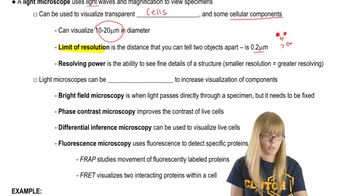
Microscopes magnify biological samples to reveal structures not visible to the naked eye, enabling detailed study of cells and organisms.
Eukaryotic cells have a nucleus and membrane-bound organelles; prokaryotic cells lack a nucleus and have no membrane-bound organelles.
Nucleus, mitochondria, endoplasmic reticulum, Golgi apparatus, lysosomes, cytoskeleton, plasma membrane, and in plants, chloroplasts and cell wall.
Plasma membrane, cytoplasm, ribosomes, nucleoid region, cell wall, and sometimes flagella or pili.
Plant cells have a cell wall, chloroplasts, and large central vacuole; animal cells lack these but have centrioles and lysosomes.
The nucleus stores genetic material (DNA) and controls cell activities by regulating gene expression.
Includes the nuclear envelope, endoplasmic reticulum, Golgi apparatus, lysosomes, vesicles, and plasma membrane, coordinating protein and lipid transport.
The RER synthesizes and processes proteins destined for membranes or secretion.
The Golgi apparatus modifies, sorts, and packages proteins and lipids for transport within or outside the cell.
The cytoskeleton provides structural support and movement; it includes microfilaments, intermediate filaments, and microtubules.
Microfilaments support cell shape and enable movement like muscle contraction and cell division.
Intermediate filaments provide mechanical strength and help maintain cell integrity.
Microtubules maintain cell shape, enable intracellular transport, and form structures like cilia and flagella.
The ECM is a network of proteins and polysaccharides outside cells that provides structural support and mediates cell communication.
Collagen, elastin, proteoglycans, and glycoproteins are key ECM components.
Types include tight junctions, desmosomes, and gap junctions, which connect cells and facilitate communication.
Plasmodesmata are channels that connect plant cells, allowing transport and communication between them.
Tight junctions seal adjacent cells to prevent leakage of molecules between them.
Desmosomes anchor cells together, providing mechanical strength to tissues.
Gap junctions allow direct cytoplasmic exchange of ions and small molecules between animal cells.