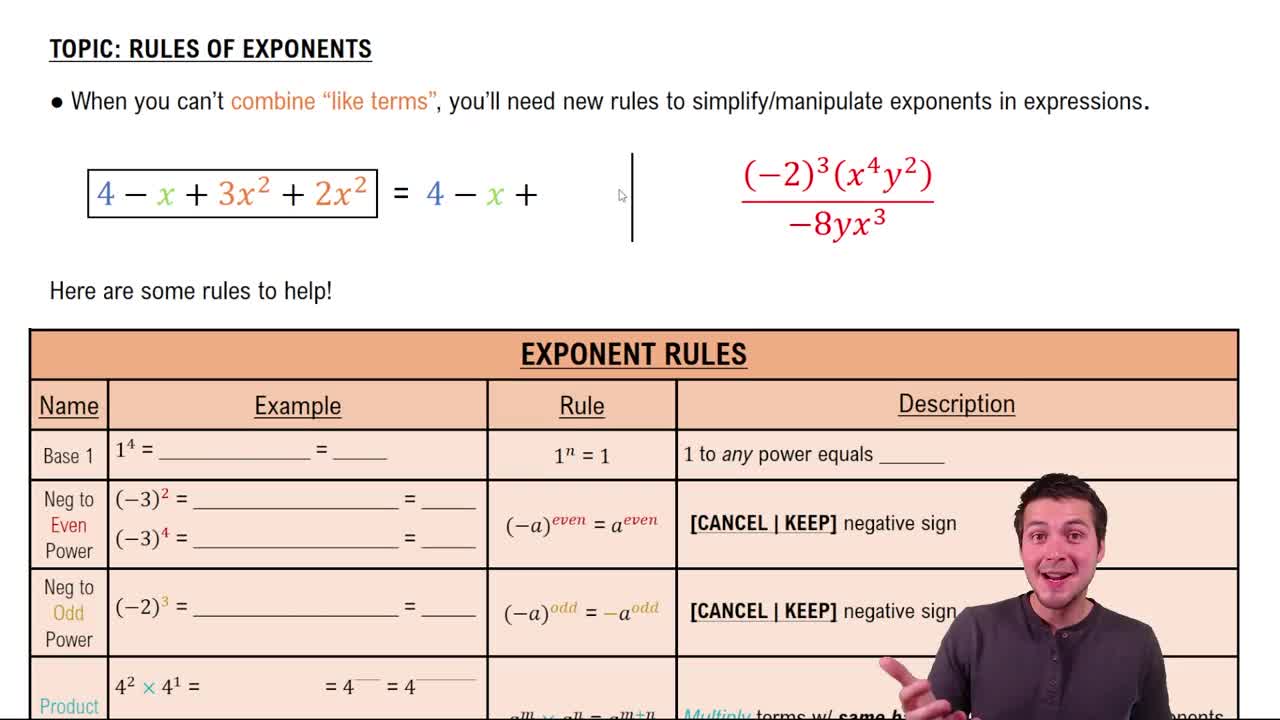
In the context of exponents, what does the exponent indicate about a number or variable?
The exponent tells how many times a number or variable is used as a factor in multiplication.
How do you determine the greatest common factor (GCF) of two monomials with the same base but different exponents, such as x^6 and x^4?
The greatest common factor of two monomials with the same base is the base raised to the lower of the two exponents. For x^6 and x^4, the GCF is x^4.
What is the result of raising 1 to any exponent?
Raising 1 to any exponent always results in 1. This is known as the base one rule.
How does a negative sign behave when a negative number is raised to an even exponent?
The negative sign cancels out when raised to an even exponent, resulting in a positive value. This applies regardless of the specific even exponent used.
What happens to the negative sign when a negative number is raised to an odd exponent?
The negative sign remains when raised to an odd exponent, so the result is negative. This is because there is always one unpaired negative factor.
What does the power rule state when you have a power raised to another power, such as (a^m)^n?
The power rule states that you multiply the exponents, so (a^m)^n becomes a^(m*n). This simplifies expressions with exponents on exponents.
How do you simplify an expression like (ab)^n using exponent rules?
You distribute the exponent to each factor inside the parentheses, so (ab)^n becomes a^n * b^n. This is called the power of a product rule.
What is the result of any nonzero number raised to the zero power?
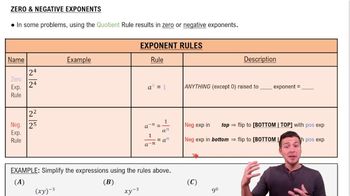
Any nonzero number raised to the zero power equals 1. The exception is 0^0, which is undefined.
How do you simplify a fraction like (a/b)^n using exponent rules?
You distribute the exponent to both the numerator and denominator, so (a/b)^n becomes a^n / b^n. This is known as the power of a quotient rule.
What is the recommended order for simplifying complex exponential expressions according to the checklist?
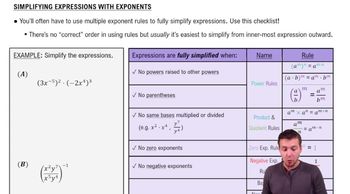
It is usually best to work from the innermost expression outward, simplifying inside parentheses first. This approach often reduces the number of terms and makes further simplification easier.
 Back
Back
 6:39
6:39