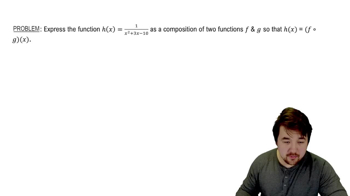
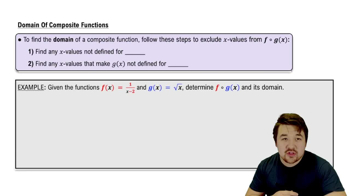
Process of creating a new function by substituting one function into another, often written as f(g(x)).
Composite Function
Resulting function formed when the output of one function becomes the input of another.
Inside Function
Function that is substituted into another function during composition, typically represented as g(x) in f(g(x)).
Outside Function
Function that receives the output of another function as its input in a composition, such as f(x) in f(g(x)).
Domain
Set of all input values for which a function or composite function is defined, considering all restrictions.
Restriction
Condition that limits the allowable input values for a function, often due to operations like division or square roots.
Notation
Standardized way of representing mathematical concepts, such as f(g(x)) or (f∘g)(x) for composition.
Evaluation
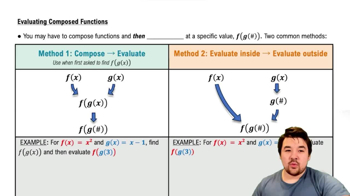
Process of finding the output of a function or composite function for a specific input value.
Decomposition
Reverse process of composition, expressing a single function as a combination of two or more simpler functions.
FOIL Method
Technique for expanding products of binomials, often used when simplifying expressions in function composition.
Square Root
Mathematical operation that finds a value which, when multiplied by itself, gives the original number; introduces domain restrictions.
Fraction
Expression representing division, where the denominator cannot be zero, affecting the domain of functions.
Simplification
Process of reducing a mathematical expression to its most concise and manageable form.
Polynomial
Algebraic expression consisting of variables and coefficients, often resulting from composing or simplifying functions.
Shortcut Method
Alternative approach for evaluating composite functions by first evaluating the inner function at a value, then using this result in the outer function.
 Back
Back

 4:26
4:26