Skip to main content
College Algebra
My Course
Learn
Exam Prep
AI Tutor
Study Guides
Textbook Solutions
Flashcards
Explore
Try the app
My Course
Learn
Exam Prep
AI Tutor
Study Guides
Textbook Solutions
Flashcards
Explore
Try the app
Back
Intro to Functions & Their Graphs definitions
1 student found this helpful
You can tap to flip the card.
Relation
You can tap to flip the card.
👆
Relation
A connection between x and y values, often represented as ordered pairs or points on a graph.
Track progress
Control buttons has been changed to "navigation" mode.
1/15
Related flashcards
Related practice
Recommended videos
Intro to Functions & Their Graphs quiz
Intro to Functions & Their Graphs
15 Terms
Intro to Functions & Their Graphs
3. Functions
7 problems
Topic
Callie
Common Functions
3. Functions
3 problems
Topic
Callie
3. Functions
5 topics
13 problems
Chapter
Callie
Guided course
3:43
Finding the Domain of an Equation
5548
views
109
rank
3
comments
Guided course
1:30
Relations & Functions Example 1
6664
views
322
rank
Guided course
5:20
Relations and Functions
12769
views
543
rank
2
comments
Terms in this set (15)
Hide definitions
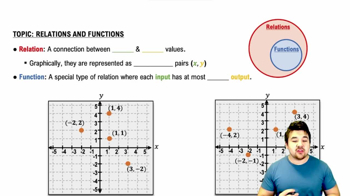
Relation
A connection between x and y values, often represented as ordered pairs or points on a graph.
Function
A special type of relation where each input is paired with at most one output.
Input
The x-value in a relation or function, representing the independent variable.
Output
The y-value in a relation or function, representing the dependent variable.
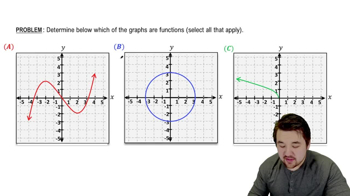
Vertical Line Test
A graphical method to determine if a graph represents a function by checking if any vertical line crosses more than one point.
Domain
The set of all possible x-values for which a function or relation is defined.
Range
The set of all possible y-values that a function or relation can produce.
Interval Notation
A way to express domains or ranges using brackets and parentheses to indicate included or excluded endpoints.
Set Builder Notation
A notation using inequalities and symbols to describe the set of values in a domain or range.
Squish Strategy
A visual technique where a graph is compressed onto an axis to identify the domain or range.
Function Notation
A symbolic way to represent functions, typically using f(x) instead of y to denote outputs.
Slope-Intercept Form
An equation format for lines, written as y = mx + b, where m is the slope and b is the y-intercept.
Denominator Restriction
A limitation in a function's domain caused by values that make the denominator zero.
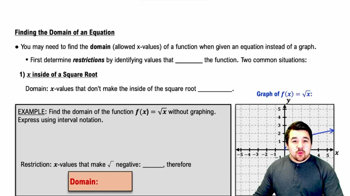
Square Root Restriction
A domain limitation that prevents negative values under a square root to avoid undefined results.
Union Symbol
A symbol used in interval notation to combine multiple intervals into a single domain or range.
 BackBack
 3:43
3:43