Introduction to Logarithms definitions Flashcards
Introduction to Logarithms definitions
You can tap to flip the card.
Control buttons has been changed to "navigation" mode.
1/15
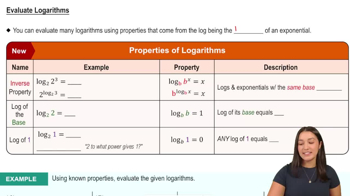
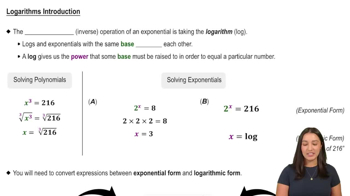
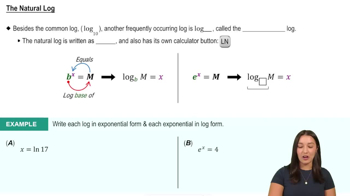
Exponential EquationAn equation where the variable appears in the exponent, often requiring logarithms to solve for the variable.LogarithmThe operation that gives the power to which a base must be raised to produce a given number; the inverse of exponentiation.BaseThe fixed number in an exponential or logarithmic expression that is raised to a power or used as the reference for the logarithm.Exponential FormA mathematical expression where a base is raised to a variable exponent, such as b^x = m.Logarithmic FormA mathematical expression showing the exponent needed for a base to reach a certain value, written as log base b of m equals x.Inverse RelationshipA connection where one operation undoes the effect of another, such as exponentiation and logarithms.Common LogarithmA logarithm with base 10, often written simply as log, and commonly used in scientific calculations.Natural LogarithmA logarithm with base e, denoted as ln, frequently used in mathematics and science for continuous growth or decay.Inverse PropertyA property stating that a logarithm and an exponential with the same base cancel each other, leaving only the exponent or argument.Logarithm of OneA property where any logarithm of 1, regardless of base, always equals 0.Logarithm of the BaseA property where the logarithm of a base to itself always equals 1.Cube RootA value that, when raised to the third power, gives the original number; can be expressed as an exponent of one third.ExponentThe power to which a base is raised in an exponential expression, indicating repeated multiplication.Special NotationUnique symbols or abbreviations, such as log for common logarithm and ln for natural logarithm, used for frequently occurring cases.Calculator ButtonA dedicated key on scientific calculators for quickly computing common and natural logarithms.