The value of log base 4 of 16 is 2, because 4 raised to the power of 2 equals 16.
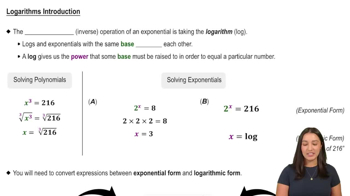
What is the inverse operation of an exponential function?
The inverse operation of an exponential function is taking the logarithm. This allows us to isolate the exponent in equations where the variable is in the exponent.
How do you convert the exponential equation 3 to the power of x equals 81 into logarithmic form?
You write it as log base 3 of 81 equals x. This expresses the equation in logarithmic form, showing the power 3 must be raised to in order to get 81.
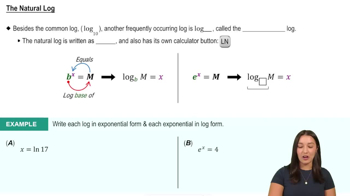
What is the special notation for log base e and how is it written?
Log base e is called the natural log and is written as ln. This notation is used instead of writing log base e explicitly.
How do you rewrite x equals ln(17) in exponential form?
You rewrite it as e to the power of x equals 17. This shows the equivalence between the logarithmic and exponential forms.
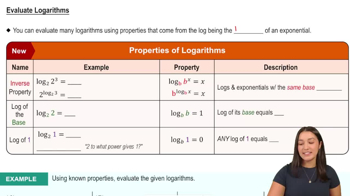
What is the value of log base 2 of 2 to the power of 3?
The value is 3 because the log and exponent with the same base cancel each other. This is an application of the inverse property.
How can you evaluate log base 5 of 1/5 without a calculator?
Rewrite 1/5 as 5 to the power of negative one, so log base 5 of 5 to the power of negative one equals negative one. The log and exponent cancel, leaving the exponent as the answer.
What is the value of the natural log of 1?
The value is 0 because any log of 1, regardless of base, equals 0. This is due to the property that any base raised to the power of 0 equals 1.
What does the common logarithm refer to and how is it notated?
The common logarithm refers to log base 10 and is simply written as log. It is frequently used and has its own calculator button.
How do you convert e to the power of x equals 4 into logarithmic form using proper notation?
You write it as ln(4) equals x, where ln denotes the natural logarithm. This expresses the equation in logarithmic form with base e.