Control buttons has been changed to "navigation" mode.
1/10
Terms in this set (10)
How do you solve the linear equation 6(x – 1) = 9(x + 2) for x?
First, distribute both sides: 6x – 6 = 9x + 18. Next, move all x terms to one side and constants to the other: 6x – 9x = 18 + 6, which gives –3x = 24. Finally, divide both sides by –3 to isolate x: x = –8.
What are the steps to solve the linear equation 9(x + 1) = 25 + x for x?
Distribute: 9x + 9 = 25 + x. Move x terms to one side: 9x – x = 25 – 9, resulting in 8x = 16. Divide both sides by 8: x = 2.
How do you solve the equation 8x – 2 – 5x = 8 for x?
Combine like terms: (8x – 5x) – 2 = 8, which simplifies to 3x – 2 = 8. Add 2 to both sides: 3x = 10. Divide both sides by 3: x = 10/3.
What is the solution for x in the equation 5(x – 10) = 30 – 15x?
Distribute: 5x – 50 = 30 – 15x. Move x terms to one side: 5x + 15x = 30 + 50, giving 20x = 80. Divide both sides by 20: x = 4.
How do you solve for x in the equation –2x + 4.4 = 23.8?
Subtract 4.4 from both sides: –2x = 23.8 – 4.4, which is –2x = 19.4. Divide both sides by –2: x = 19.4 / (–2) = –9.7.
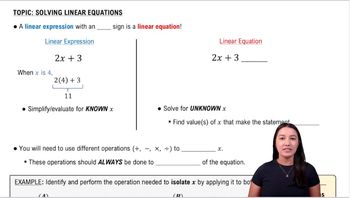
What general steps should you follow to solve a linear equation for x?
1. Distribute any constants if needed. 2. Combine like terms. 3. Move all x terms to one side and constants to the other. 4. Isolate x by performing the opposite operation (addition/subtraction/multiplication/division) on both sides. 5. Check your solution by substituting x back into the original equation.
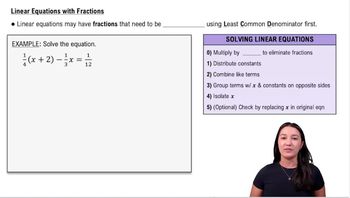
What is the first step when solving a linear equation that contains fractions?
Multiply both sides of the equation by the least common denominator to eliminate all fractions. This simplifies the equation and makes it easier to solve.
How do you check if your solution to a linear equation is correct?
Substitute the value you found for x back into the original equation. If both sides of the equation are equal, your solution is correct.
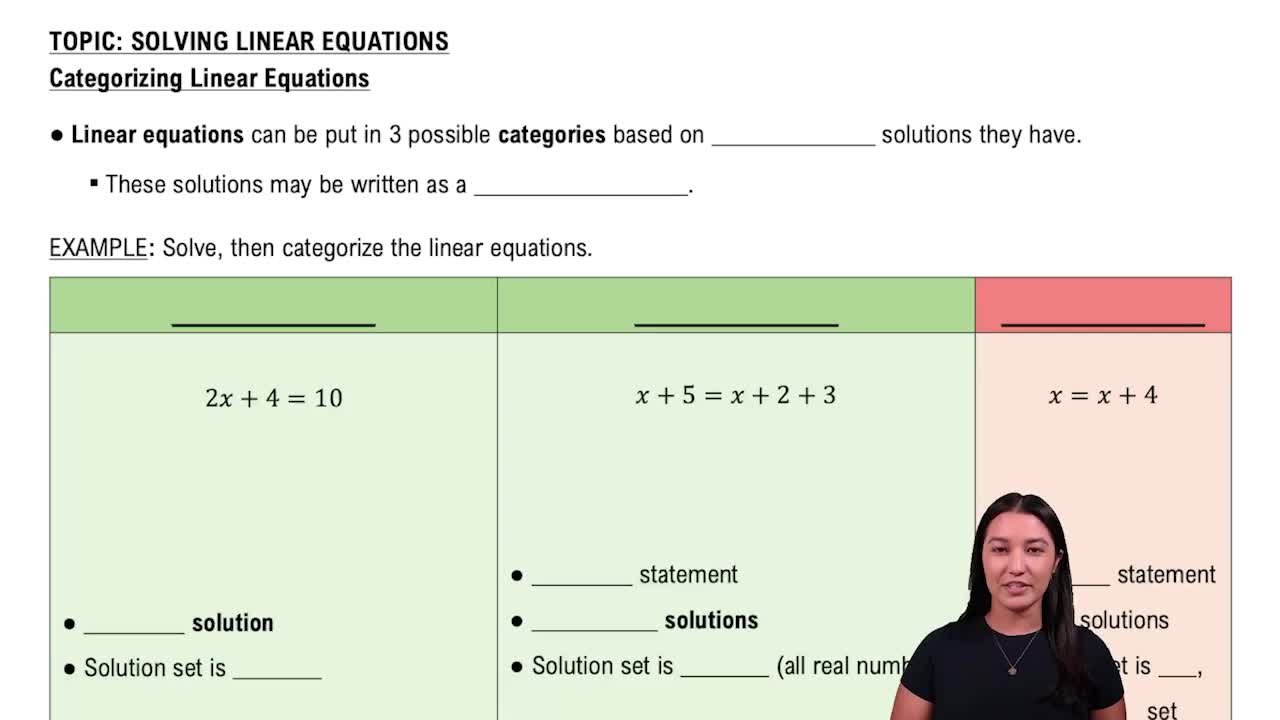
What does it mean if solving a linear equation results in a statement like 0 = 0?
It means the equation is true for all values of x, so there are infinite solutions. This type of equation is called an identity equation.
How is the solution set for a linear equation with no solutions written in set notation?
The solution set is written as curly brackets containing a zero with a slash through it, representing the empty set. This indicates that there is no value of x that satisfies the equation.