Powers of i definitions Flashcards
You can tap to flip the card.
Control buttons has been changed to "navigation" mode.
1/15
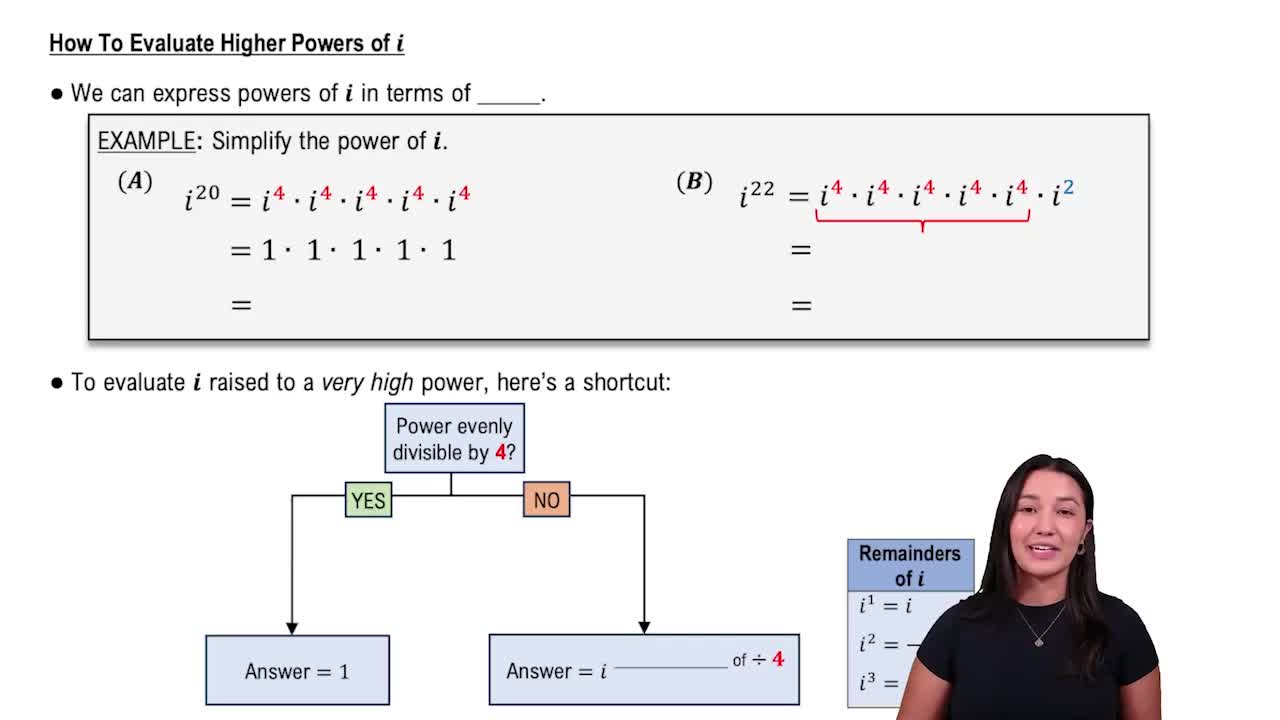
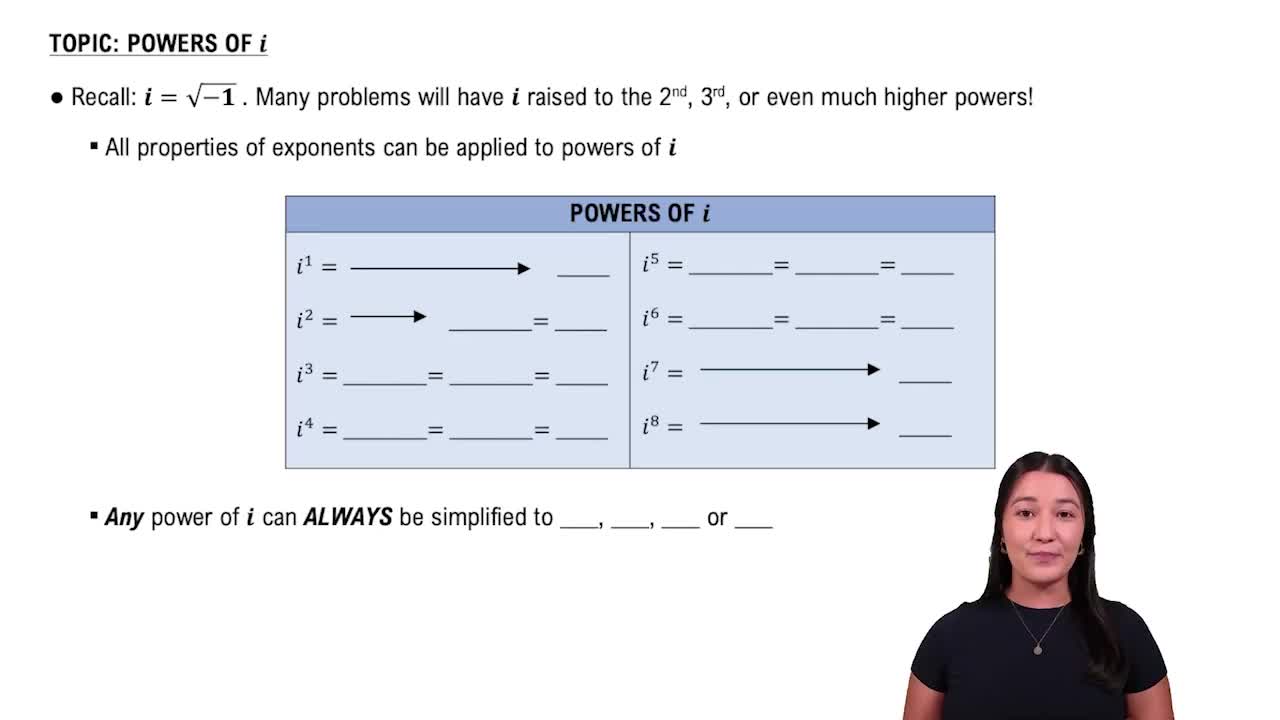
Imaginary UnitA mathematical concept defined as the square root of negative one, enabling solutions to equations lacking real roots.ExponentA number indicating how many times a base is multiplied by itself, crucial for expressing repeated multiplication.Power CycleA repeating sequence of results obtained when raising a number, such as i, to successive integer exponents.RemainderThe amount left over after division, used to determine the equivalent lower power in cycles of exponents.DivisibilityA property describing whether one integer can be divided by another without leaving a remainder.Radical RuleA guideline for manipulating expressions involving roots, such as simplifying the square root of negative numbers.Properties of ExponentsA set of rules governing operations involving powers, such as multiplying like bases or raising a power to a power.Pattern RecognitionThe process of identifying recurring sequences or structures, essential for simplifying powers of i.Long DivisionA step-by-step method for dividing large numbers, often used to find remainders in exponent problems.Equivalent PowerA lower exponent that produces the same result as a higher exponent due to cyclical behavior.Negative OneA value resulting from squaring the imaginary unit, representing a fundamental result in complex numbers.Negative iA value in the cycle of powers of the imaginary unit, specifically the result of raising i to the third power.Positive OneA value in the cycle of powers of the imaginary unit, occurring every fourth exponent.Cycle LengthThe number of steps before a repeating pattern restarts, which is four for powers of i.Complex NumberA number composed of a real part and an imaginary part, often involving the imaginary unit.