College Algebra
My Course
Learn
Exam Prep
AI Tutor
Study Guides
Textbook Solutions
Flashcards
Explore
My Course
Learn
Exam Prep
AI Tutor
Study Guides
Textbook Solutions
Flashcards
Explore
Back
Solving Exponential and Logarithmic Equations definitions
You can tap to flip the card.
Exponential Equation
You can tap to
flip the card.
👆
Exponential Equation
An equation where the variable appears in the exponent, often requiring base rewriting or logarithms to solve.
Track progress
Control buttons has been changed to "navigation" mode.
1/15
Related flashcards
Related practice
Recommended videos
Guided course
4:46
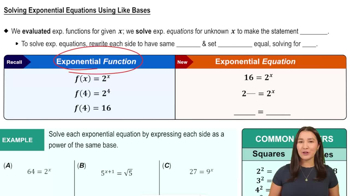
Solving Exponential Equations Using Like Bases
Patrick
1908
views
19
rank
Guided course
5:47
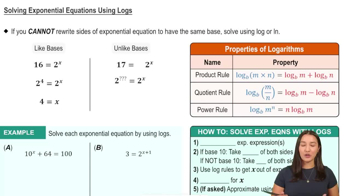
Solving Exponential Equations Using Logs
Patrick
1235
views
15
rank
1
comments
Guided course
5:02
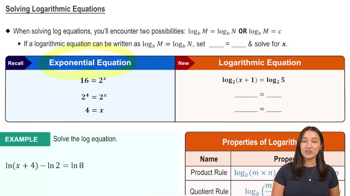
Solving Logarithmic Equations
Patrick
1018
views
9
rank
Terms in this set (15)
Hide definitions
Exponential Equation
An equation where the variable appears in the exponent, often requiring base rewriting or logarithms to solve.
Logarithmic Equation
An equation involving a logarithm with the variable inside, typically solved by converting to exponential form or using log properties.
Base
The constant value that is raised to a power in exponential or logarithmic expressions, crucial for rewriting and solving equations.
Exponent
The power to which a base is raised, often containing the variable to be solved in exponential equations.
Natural Logarithm
A logarithm with base e, commonly used when the exponential base is not 10, denoted as ln.
Common Logarithm
A logarithm with base 10, typically written as log, used when the exponential base is 10.
Power Rule
A logarithmic property allowing exponents inside a log to be moved in front as a multiplier, aiding in isolating variables.
Quotient Rule
A logarithmic property stating that the log of a quotient equals the difference of the logs, useful for condensing expressions.
Isolated Exponential Expression
An exponential term arranged alone on one side of an equation, a key step before applying logarithms.
Exponential Form
A mathematical expression where a base is raised to an exponent, often used to rewrite logarithmic equations for solving.
Logarithmic Form
An expression representing the exponent needed to obtain a number from a given base, used to solve exponential equations.
Linear Equation
A simplified equation with the variable to the first power, often resulting from solving exponential or logarithmic equations.
Undefined Logarithm
A situation where the argument of a logarithm is negative or zero, making the expression invalid and the solution extraneous.
Like Bases
Identical bases on both sides of an equation, allowing exponents to be set equal for straightforward solving.
Approximate Solution
A decimal value for a variable, typically found using a calculator after applying logarithms or other properties.