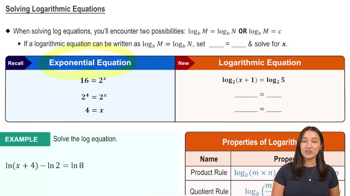
To solve for x when log(x) = β0.123, rewrite the equation in exponential form: x = 10^(β0.123).
What is the method to solve the logarithmic equation log(25x) = 3 for x?
To solve log(25x) = 3, rewrite the equation in exponential form: 25x = 10^3. Then solve for x: x = 10^3 / 25.
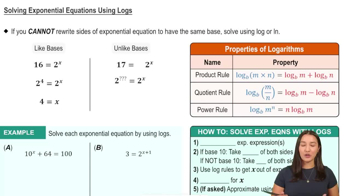
What is the first step when solving an exponential equation like 10^x + 64 = 100?
The first step is to isolate the exponential expression by subtracting 64 from both sides. This gives 10^x = 36.
When should you use the natural log instead of the common log to solve an exponential equation?
Use the natural log when the base of the exponential expression is not 10. For example, for 2^x, use the natural log.
How do you apply the power rule of logarithms when solving equations like ln(2^(x+1))?
The power rule allows you to bring the exponent to the front: ln(2^(x+1)) becomes (x+1)ln(2). This helps isolate x.
What should you do after converting a logarithmic equation to exponential form?
After converting to exponential form, solve the resulting linear equation for x. Then check that the solution does not make the log argument negative.
Why is it important to check your solution when solving logarithmic equations?
It is important because the logarithm of a negative number is undefined. If your solution makes the log argument negative, it is not valid.
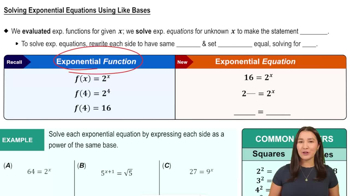
How can you rewrite the square root of 5 as an exponent with base 5?
The square root of 5 can be written as 5^(1/2). This allows you to match bases in exponential equations.
What is the quotient rule for logarithms and how is it used in solving equations?
The quotient rule states that log(a) - log(b) = log(a/b). It is used to condense logarithmic expressions before solving.
What do you do if you cannot rewrite both sides of an exponential equation with the same base?
If you cannot rewrite both sides with the same base, use logarithms to solve for the exponent. Take the log or natural log of both sides and apply log rules.