Pearson+ LogoPearson+ Logo

The Quadratic Formula quiz #1 Flashcards

Back
The Quadratic Formula quiz #1
Control buttons has been changed to "navigation" mode.
1/10
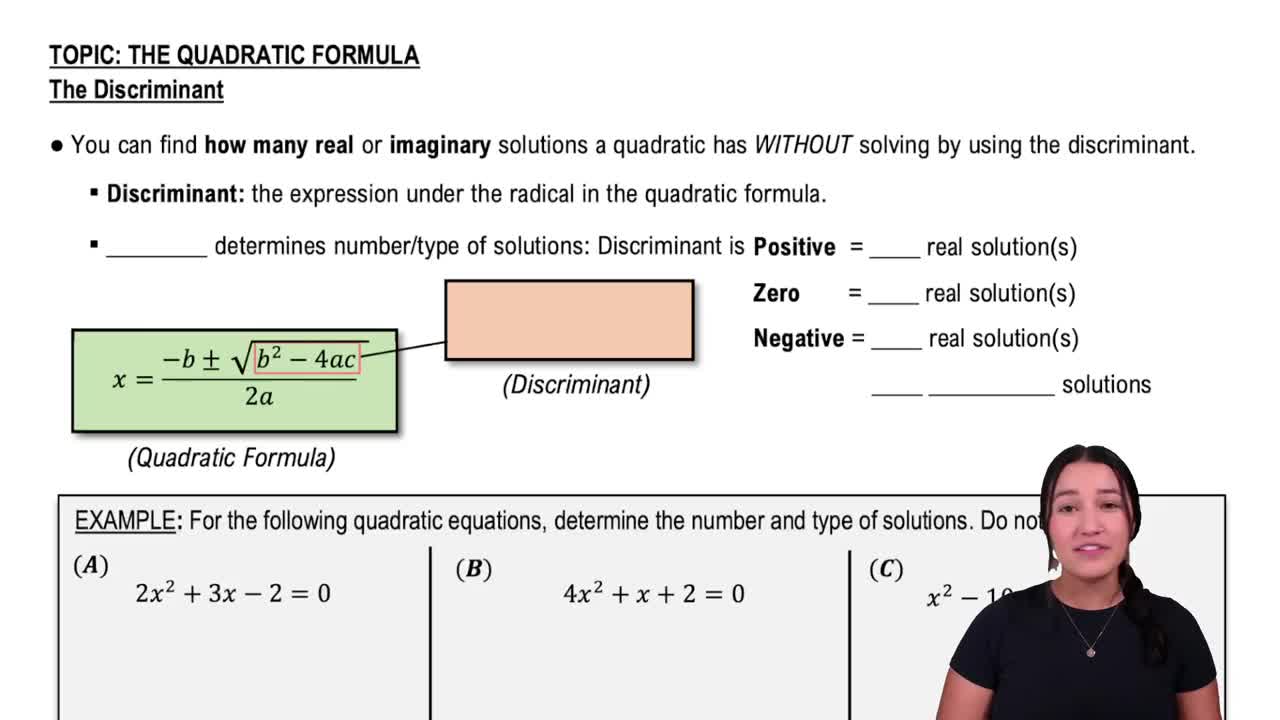
  • How do you find the discriminant of a quadratic equation in the form ax^2 + bx + c = 0?

    To find the discriminant of a quadratic equation, use the formula b^2 - 4ac, where a, b, and c are the coefficients from the equation ax^2 + bx + c = 0.
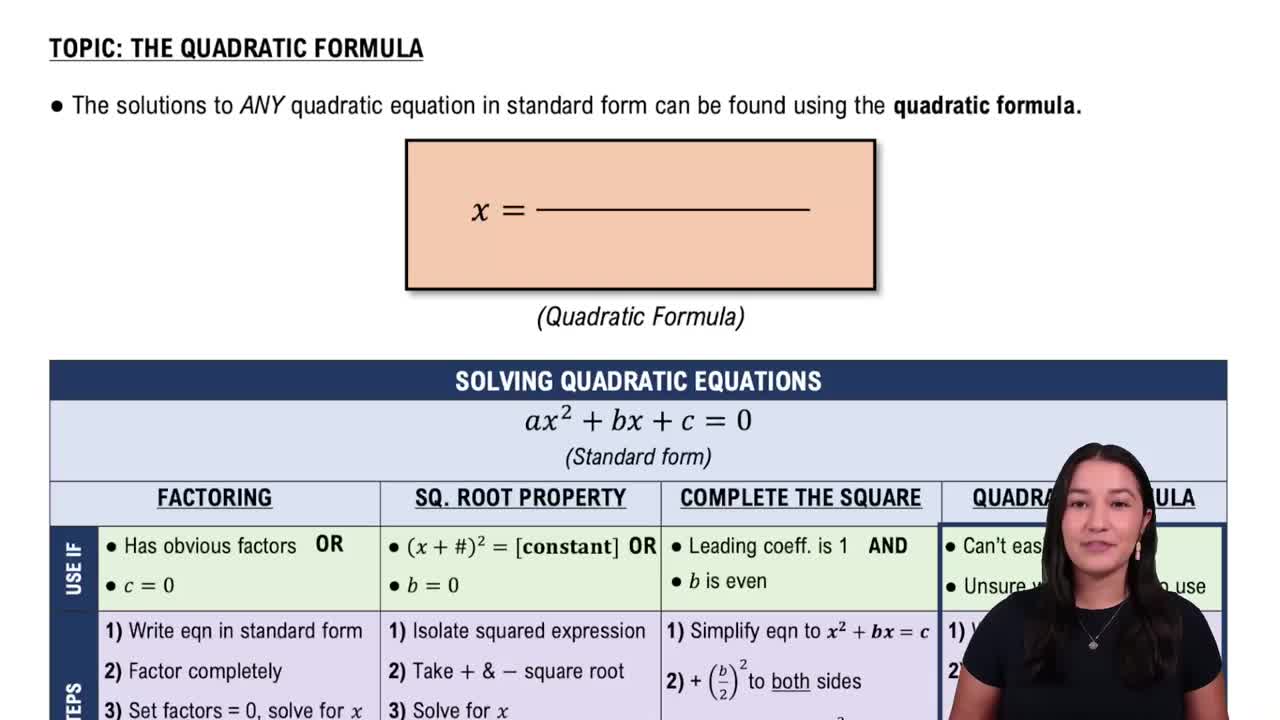
  • What is the correct form of the quadratic formula for solving ax^2 + bx + c = 0?

    The quadratic formula is x = (-b ± √(b^2 - 4ac)) / (2a), where a, b, and c are the coefficients of the quadratic equation.
  • What does the discriminant tell you about the solutions of a quadratic equation?

    The discriminant (b^2 - 4ac) indicates the nature and number of solutions: if positive, there are two real solutions; if zero, one real solution; if negative, two imaginary solutions.
  • Who invented the quadratic formula?

    The quadratic formula was developed over centuries by mathematicians from ancient Babylon, India, and the Islamic Golden Age; it does not have a single inventor.
  • What is the first step you should always take before applying the quadratic formula to an equation?

    The first step is to write the equation in standard form, ax^2 + bx + c = 0. This ensures you can correctly identify the values of a, b, and c.
  • Why is it important to pay attention to the signs of a, b, and c when using the quadratic formula?

    Incorrect signs can lead to wrong calculations under the square root and in the formula. Always include the correct positive or negative values for accurate solutions.
  • What should you do after plugging a, b, and c into the quadratic formula?

    After plugging in the values, simplify the expression under the square root and the rest of the formula. Then split the solution into the plus and minus cases to find both answers.
  • If the expression under the square root in the quadratic formula cannot be simplified to a whole number, what should you do?

    Leave the solution in terms of the square root if it cannot be simplified further. This is an acceptable final answer when the radical does not simplify to a whole number.
  • How can the discriminant help you avoid fully solving a quadratic equation?

    By calculating the discriminant, you can quickly determine the number and type of solutions. This saves time if you only need to know whether solutions are real or imaginary.
  • What does it mean if the discriminant of a quadratic equation is negative?

    A negative discriminant means the equation has no real solutions and instead has two imaginary solutions. This result comes from taking the square root of a negative number.