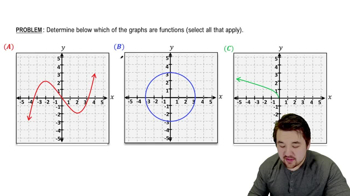
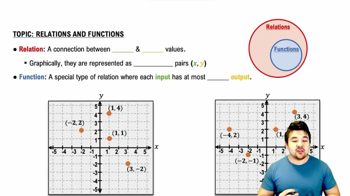
What is the inverse of a function F defined by ordered pairs?
The inverse function G is formed by interchanging the x and y values of each ordered pair in F.
What condition must a function satisfy to have an inverse that is also a function?
The function must be one-to-one, meaning each x corresponds to only one y, and each y corresponds to only one x.
How is the inverse function of f denoted?
The inverse function of f is denoted as \(f^{-1}\) and read as 'f inverse.'
What is the relationship between the domain and range of a function and its inverse?
The domain of f is the range of \(f^{-1}\), and the range of f is the domain of \(f^{-1}\).
What does the horizontal line test determine?
It determines if a function is one-to-one by checking if any horizontal line intersects the graph more than once; if so, the function is not one-to-one.
State the definition of inverse functions using composition.
Functions f and g are inverses if (f∘g)(x) = x and (g∘f)(x) = x for all x in their domains.
What are the steps to find the equation of the inverse function of y = f(x)?
1. Replace f(x) with y. 2. Interchange x and y. 3. Solve for y. 4. Replace y with \(f^{-1}(x)\).
How do you add two functions f(x) and g(x)?
The sum is (f + g)(x) = f(x) + g(x).
How do you subtract two functions f(x) and g(x)?
The difference is (f - g)(x) = f(x) - g(x).
How do you multiply two functions f(x) and g(x)?
The product is (fg)(x) = f(x) * g(x).
How do you divide two functions f(x) and g(x), where g(x) ≠ 0?
The quotient is (f/g)(x) = f(x) / g(x).
What is the composition of functions (f∘g)(x)?
(f∘g)(x) = f(g(x)), meaning you apply g first, then f.
What is the composition of functions (g∘f)(x)?
(g∘f)(x) = g(f(x)), meaning you apply f first, then g.
If f(x) = 2x + 5, what is the inverse function f⁻¹(x)?
Interchange x and y: x = 2y + 5, solve for y: y = (x - 5)/2, so \(f^{-1}(x) = \frac{x-5}{2}\).
If f(x) = x - 7, what is the inverse function f⁻¹(x)?
Interchange x and y: x = y - 7, solve for y: y = x + 7, so \(f^{-1}(x) = x + 7\).
What does it mean for a function to be one-to-one?
Each input x corresponds to exactly one output y, and each output y corresponds to exactly one input x.
How can you verify if two functions f and g are inverses using their formulas?
Check if (f∘g)(x) = x and (g∘f)(x) = x for all x in their domains.
What happens if a horizontal line intersects a function's graph more than once?
The function is not one-to-one and does not have an inverse function.
If f(x) = 3x - 6 and g(x) = (x/3) + 2, are f and g inverses?
Check compositions: (f∘g)(x) = x and (g∘f)(x) = x; if true, then yes, they are inverses.
If f(x) = -5x + 9 and g(x) = -(1/5)x - 9, are f and g inverses?
Check compositions: (f∘g)(x) ≠ x or (g∘f)(x) ≠ x, so they are not inverses.
 Back
 3:43