Skip to main content
College Algebra
My Course
Learn
Exam Prep
AI Tutor
Study Guides
Textbook Solutions
Flashcards
Explore
Try the app
My Course
Learn
Exam Prep
AI Tutor
Study Guides
Textbook Solutions
Flashcards
Explore
Try the app
Back
College Algebra Midterm Key Concepts and Problems
You can tap to flip the card.
Evaluate 2(x + 3) − 12 when x = −4
You can tap to flip the card.
👆
Evaluate 2(x + 3) − 12 when x = −4
Substitute x = −4: 2(−4 + 3) − 12 = 2(−1) − 12 = −2 − 12 = −14.
Track progress
Control buttons has been changed to "navigation" mode.
1/24
Recommended videos
Guided course
03:11
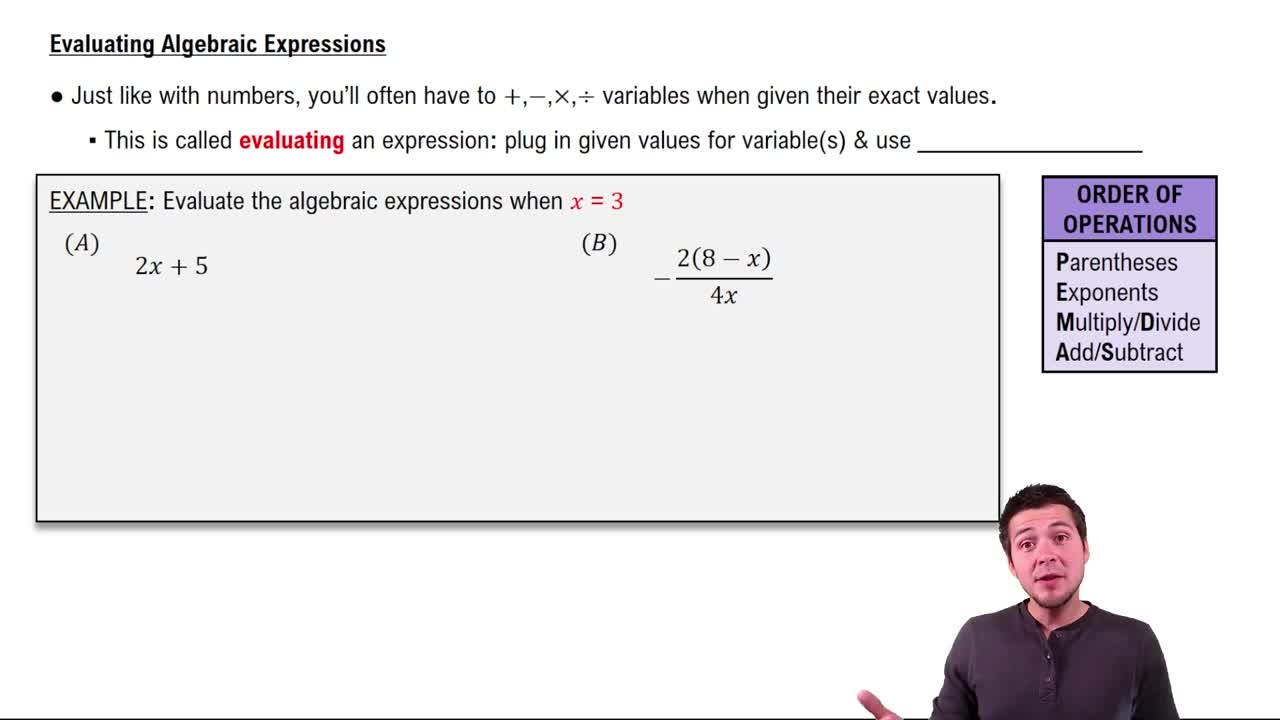
Evaluating Algebraic Expressions
14645
views
771
rank
10
comments
Guided course
05:09
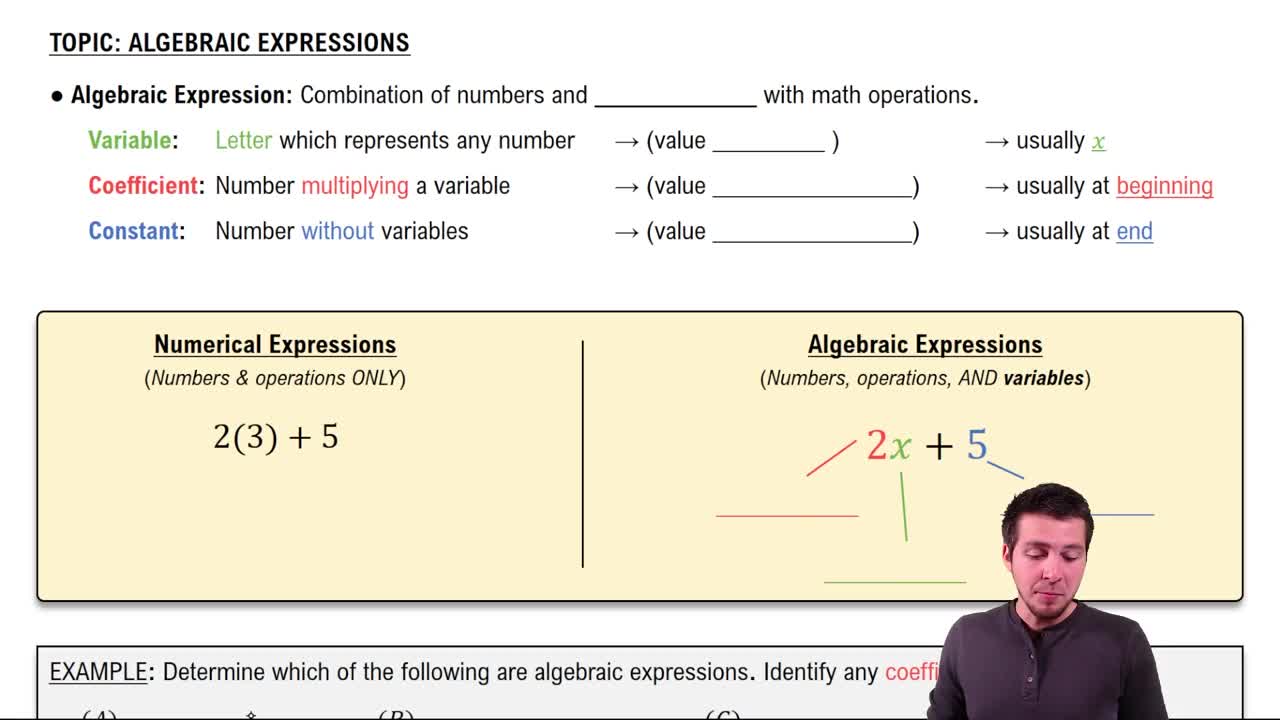
Introduction to Algebraic Expressions
25865
views
1161
rank
8
comments
Guided course
1:51
Introduction to College Algebra Channel
20437
views
671
rank
1
comments
Terms in this set (24)
Hide definitions
Evaluate 2(x + 3) − 12 when x = −4
Substitute x = −4: 2(−4 + 3) − 12 = 2(−1) − 12 = −2 − 12 = −14.
Write 3.1642 × 10^6 in standard notation
Move decimal 6 places right: 3,164,200.
Simplify 8x^3 / (2x)^2
Rewrite denominator: (2x)^2 = 4x^2. Then 8x^3 / 4x^2 = 2x.
Subtract (13w³ + 2w² − 3) − (6w² + 5w − 3)
Result: 13w³ + 2w² − 3 − 6w² − 5w + 3 = 13w³ − 4w² − 5w.
Multiply (b − 2)(b² − 4b + 4)
Use distributive property: b³ − 4b² + 4b − 2b² + 8b − 8 = b³ − 6b² + 12b − 8.
Factor 16x² − 81
Difference of squares: (4x − 9)(4x + 9).
Factor y² + 12y + 36
Perfect square trinomial: (y + 6)².
Find the y-intercept for 2x − 5y = 6
Set x=0: −5y=6 → y=−6/5.
Distance between (5, −3) and (−2, 8)
Distance = √[(−2−5)² + (8+3)²] = √[49 + 121] = √170.
Midpoint between (5, −3) and (−2, 8)
Midpoint = ((5−2)/2, (−3+8)/2) = (1.5, 2.5).
Interval notation for {x | x ≤ 10}
Interval: (−∞, 10].
Solve |3x − 2| ≥ 4
3x − 2 ≥ 4 or 3x − 2 ≤ −4 → x ≥ 2 or x ≤ −2/3.
Equation of line through (−4, 2) and (5, −3)
Slope m = (−3−2)/(5+4) = −5/9; equation: y − 2 = (−5/9)(x + 4).
Add (3 − 2i) + (4 − i)
Sum: (3+4) + (−2i − i) = 7 − 3i.
Multiply (14 − 3i)(8 + 5i)
Product: 14×8 + 14×5i − 3i×8 − 3i×5i = 112 + 70i − 24i − 15i² = 112 + 46i + 15 = 127 + 46i.
Solve 4x² − 4x = 1
Rewrite: 4x² − 4x − 1 = 0; use quadratic formula.
Find domain of g(x) = 8 − x
Domain: all real numbers (−∞, ∞).
Compute (f ○ g)(4) for f(x) = 3x² − 10, g(x) = 2x + 5
g(4) = 2(4) + 5 = 13; f(13) = 3(13)² − 10 = 3(169) − 10 = 497.
Find inverse of f(x) = 0.5√(x − 3)
Swap x and y: x = 0.5√(y − 3); solve for y: y = 4x² + 3.
Determine if f(x) = −3x² + 4 is one-to-one
No, because it is a quadratic (parabola) failing the horizontal line test.
Write quadratic function in standard form: y = x² + 2x − 8
Complete the square: y = (x + 1)² − 9.
Use Rational Root Theorem on f(x) = 4x⁴ + 8x³ + 21x² + 17x + 4
Possible rational roots are ± factors of 4 over factors of 4: ±1, ±2, ±4, ±1/2, ±3/4, etc.
Find vertical asymptote(s) of f(x) = (x + 4) / (x² − 2x − 3)
Denominator zeroes: x² − 2x − 3 = (x − 3)(x + 1) = 0 → x = 3, −1 vertical asymptotes.
Find slant asymptote of g(x) = (x² + 3x − 3) / (x − 1)
Divide numerator by denominator: quotient is x + 4; slant asymptote y = x + 4.
 BackBack
 03:11