Skip to main content
College Algebra
My Course
Learn
Exam Prep
AI Tutor
Study Guides
Textbook Solutions
Flashcards
Explore
Try the app
My Course
Learn
Exam Prep
AI Tutor
Study Guides
Textbook Solutions
Flashcards
Explore
Try the app
Back
College Algebra: Unit Analysis and Problem Solving
You can tap to flip the card.
What is the three-step problem-solving approach emphasized in unit analysis?
You can tap to flip the card.
👆
What is the three-step problem-solving approach emphasized in unit analysis?
Understand
the problem,
Solve
using unit analysis and calculations, and
Explain
the solution clearly with units.
Track progress
Control buttons has been changed to "navigation" mode.
1/26
Recommended videos
Guided course
03:11
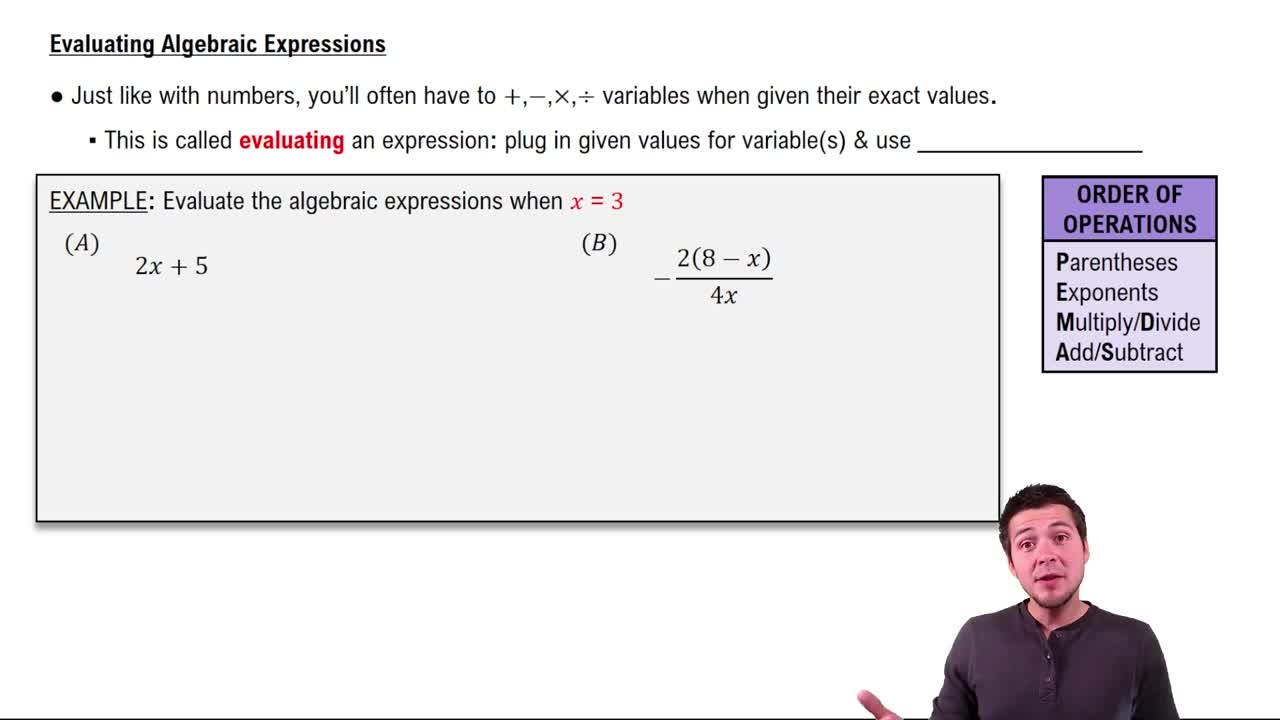
Evaluating Algebraic Expressions
14645
views
771
rank
10
comments
Guided course
05:09
Introduction to Algebraic Expressions
25865
views
1161
rank
8
comments
Guided course
1:51
Introduction to College Algebra Channel
20437
views
671
rank
1
comments
Terms in this set (26)
Hide definitions
What is the three-step problem-solving approach emphasized in unit analysis?
Understand
the problem,
Solve
using unit analysis and calculations, and
Explain
the solution clearly with units.
How do you multiply two fractions?
Multiply the numerators together and multiply the denominators together to get the product fraction.
What is the 'invert and multiply' rule for dividing fractions?
Divide two fractions by multiplying the first fraction by the reciprocal of the second fraction.
How can division by a number be thought of in terms of multiplication?
Division by a number is equivalent to multiplying by its reciprocal.
Convert the fraction 2/3 to a decimal.
2/3 as a decimal is approximately 0.6667.
Write the decimal 0.45 as a fraction.
0.45 as a fraction is \(\frac{9}{20}\).
How do you calculate speed given distance and time?
Speed is calculated as \(\text{speed} = \frac{\text{distance}}{\text{time}}\).
If Earth’s equator is 25,000 miles and it rotates in 24 hours, what is the speed of rotation at the equator?
Speed = 25,000 miles / 24 hours ≈ 1041.67 miles per hour.
How do you find the total weight of multiple objects given the weight of one?
Multiply the number of objects by the weight of one object.
What is the total weight of 11 basketballs weighing 22 ounces each?
Total weight = 11 × 22 ounces = 242 ounces.
How do you convert feet to yards?
Divide the number of feet by 3 since 1 yard = 3 feet.
Convert 16 feet to yards.
16 feet ÷ 3 = 5.33 yards.
How do you convert years to days ignoring leap years?
Multiply years by 365 days per year.
Convert 17 years to days (ignoring leap years).
17 × 365 = 6205 days.
How do you convert inches to miles using given unit conversions?
Convert inches to feet, feet to yards, then yards to miles using 12 in = 1 ft, 3 ft = 1 yd, 1760 yd = 1 mi.
Find the area in square feet of a yard measuring 20 yards by 12 yards.
Area = 20 yd × 12 yd = 240 yd²; convert to square feet: 240 × 9 = 2160 ft².
How to calculate volume in cubic yards for a sidewalk 4 ft wide, 150 ft long, and 0.5 ft deep?
Volume in cubic feet = 4 × 150 × 0.5 = 300 ft³; convert to cubic yards: 300 ÷ 27 ≈ 11.11 yd³.
How to calculate the time to fill a 400-gallon hot tub with a hose filling at 4.5 gallons per minute?
Time = 400 gallons ÷ 4.5 gallons/min ≈ 88.89 minutes.
How to calculate monthly earnings if earning \$15.30/hour and working 24 eight-hour days?
Monthly earnings = \$15.30 × 8 hours/day × 24 days = \$2,937.60.
How to estimate gas mileage for a 2000-mile trip averaging 32 miles per gallon?
Gas needed = 2000 miles ÷ 32 mpg = 62.5 gallons.
Would a car that gets 16 miles per gallon require twice as much gas as one that gets 32 mpg for the same trip?
Yes, because 16 mpg is half the efficiency, so it requires twice the gas.
How to calculate average hot air exhaled per day if a person breathes 6 times per minute and exhales 1 liter each time?
Daily exhaled air = 6 breaths/min × 1 liter × 60 min/hr × 24 hr = 8640 liters.
How to calculate speed in feet per second from miles per hour?
Convert miles to feet (1 mile = 5280 feet) and hours to seconds (1 hour = 3600 seconds), then divide.
Felix Baumgartner reached 834 mph. How many feet per second is this?
Speed = 834 miles/hr × 5280 ft/mile ÷ 3600 sec/hr ≈ 1223.47 ft/sec.
How to calculate average pay per game if salary and games played are known?
Average pay per game = total salary ÷ number of games.
If a player earns \$314 million over 5 years playing 80 games per season, what is the average pay per game?
Total games = 5 × 80 = 400; pay per game = \$314,000,000 ÷ 400 = \$785,000.
 BackBack
 03:11