Skip to main content
Financial Accounting
My Course
Learn
Exam Prep
AI Tutor
Study Guides
Flashcards
Explore
Try the app
My Course
Learn
Exam Prep
AI Tutor
Study Guides
Flashcards
Explore
Try the app
Back
Adjusting Entries: Accrued Revenues definitions
You can tap to flip the card.
Accrued Revenues
You can tap to flip the card.
👆
Accrued Revenues
Earnings recognized before cash is received, typically from delivering goods or services on credit to customers.
Track progress
Control buttons has been changed to "navigation" mode.
1/13
Related flashcards
Related practice
Recommended videos
Adjusting Entries: Accrued Revenues quiz #1
Adjusting Entries: Accrued Revenues
24 Terms
Adjusting Entries: Accrued Revenues
3. Accrual Accounting Concepts
10 problems
Topic
Adjusting Entries: Depreciation
3. Accrual Accounting Concepts
10 problems
Topic
3. Accrual Accounting Concepts
12 topics
14 problems
Chapter
Guided course
04:56
Adjusting Journal Entries: Accrued Revenues
2464
views
44
rank
Terms in this set (13)
Hide definitions
Accrued Revenues
Earnings recognized before cash is received, typically from delivering goods or services on credit to customers.
Accounts Receivable
Asset representing amounts owed by customers who have received goods or services but have not yet paid.
Asset
Resource owned by a company, such as money owed by customers, that provides future economic benefit.
Revenue Recognition Principle
Guideline requiring revenue to be recorded when it is earned, regardless of when cash is received.
Credit Sale
Transaction where goods or services are provided to a customer who agrees to pay at a later date.
Adjusting Entry
Accounting record made at the end of a period to update account balances before preparing financial statements.
Debit
Accounting entry that increases assets or expenses and decreases liabilities or equity.
Credit
Accounting entry that increases liabilities, equity, or revenue and decreases assets or expenses.
Outstanding Balance
Portion of an amount owed by a customer that remains unpaid after a partial payment.
Accrual Accounting
Method where transactions are recorded when they occur, not when cash is exchanged.
On Account
Term indicating a transaction where payment is deferred and will be made at a future date.
IOU
Informal reference to an amount owed by a customer, reflected as an asset until payment is received.
Partial Payment
Situation where a customer pays only a portion of the total amount owed, leaving a remaining balance.
 BackBack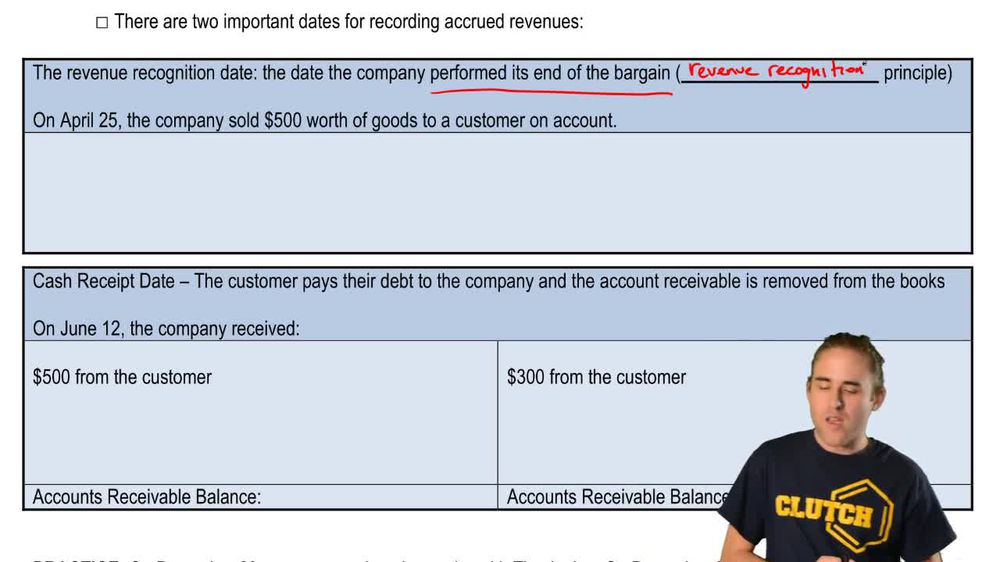
 04:56
04:56