What is the significance of the order of liquidity for current assets?
The order of liquidity shows which assets can be most quickly converted to cash to meet obligations.
How are buildings classified on a classified balance sheet?
Buildings are classified as long-term assets.
What does the classified balance sheet reveal about a company's obligations?
It reveals which obligations are due soon (current liabilities) and which are due later (long-term liabilities).
How are accounts receivable classified on a balance sheet?
Accounts receivable are classified as current assets.
What is the main advantage of using a classified balance sheet?
The main advantage is that it provides a clearer and more organized view of a company's financial position.
How are land and machinery classified on a balance sheet?
Land and machinery are classified as long-term assets.
What information does a classified balance sheet provide to investors?
It provides information about a company's liquidity, solvency, and overall financial structure.
What is the main difference between current and long-term assets on a classified balance sheet?
Current assets are expected to be converted into cash within one year, while long-term assets are used for more than one year.
In what order are current assets typically listed on a classified balance sheet, and why?
Current assets are listed in order of liquidity, starting with cash, then marketable securities, accounts receivable, inventory, and prepaid expenses, to show which assets can be most quickly converted to cash.
How is inventory classified on the balance sheet?
Inventory is classified as a current asset on the balance sheet.
What is an unclassified balance sheet?
An unclassified balance sheet lists assets, liabilities, and equity without grouping them into current and long-term categories.
What liability subsections are shown on a classified balance sheet?
A classified balance sheet shows liabilities divided into current liabilities and long-term liabilities.
How does an unclassified balance sheet differ from a classified balance sheet?
An unclassified balance sheet does not separate assets and liabilities into current and long-term categories, while a classified balance sheet does.
What asset subsections are shown on a classified balance sheet?
A classified balance sheet shows assets divided into current assets and long-term assets.
Is merchandise inventory considered a long-term asset?
No, merchandise inventory is not considered a long-term asset; it is a current asset.
How are buildings classified on the balance sheet?
Buildings are classified as long-term assets on the balance sheet.
Is merchandise inventory a current asset?
Yes, merchandise inventory is a current asset.
What is a classified balance sheet?
A classified balance sheet organizes assets and liabilities into current and long-term categories, providing more detail about their timing.
How are fixed assets ordinarily presented on the balance sheet?
Fixed assets are presented as long-term assets on the balance sheet.
How is merchandise inventory classified on the balance sheet?
Merchandise inventory is classified as a current asset on the balance sheet.
In terms of liquidity, how is inventory ranked among current assets?
Inventory is less liquid than cash, marketable securities, and accounts receivable, but more liquid than prepaid expenses.
Is merchandise inventory a long-term asset?
No, merchandise inventory is a current asset, not a long-term asset.
What is an example of a shareholders' equity account on the balance sheet?
Common stock is an example of a shareholders' equity account on the balance sheet.
Which type of account does not appear on the balance sheet?
Revenue and expense accounts do not appear on the balance sheet; only assets, liabilities, and equity accounts are shown.
Which type of account is not included on the balance sheet?
Income statement accounts, such as revenues and expenses, are not included on the balance sheet.
What types of items are included on the balance sheet?
The balance sheet includes assets, liabilities, and shareholders' equity.
What information does a classified balance sheet provide?
A classified balance sheet provides a detailed breakdown of assets and liabilities into current and long-term categories.
How are liabilities listed on the balance sheet?
Liabilities are listed in order of maturity, starting with current liabilities (due within one year) followed by long-term liabilities.
How are assets typically organized on a balance sheet?
Assets are typically organized in order of liquidity, starting with the most liquid (cash) and ending with the least liquid.
In what order are assets listed on the balance sheet?
Assets are listed in order of liquidity, from most liquid (cash) to least liquid (such as prepaid expenses).
How are assets listed on the balance sheet?
Assets are listed in order of liquidity, beginning with cash, followed by marketable securities, accounts receivable, inventory, and prepaid expenses.
What is the primary limitation of the balance sheet?
The primary limitation of the balance sheet is that it presents a snapshot at a single point in time and may not reflect current market values.
What are the main sections of a balance sheet?
The main sections of a balance sheet are assets, liabilities, and shareholders' equity.
 Back
Back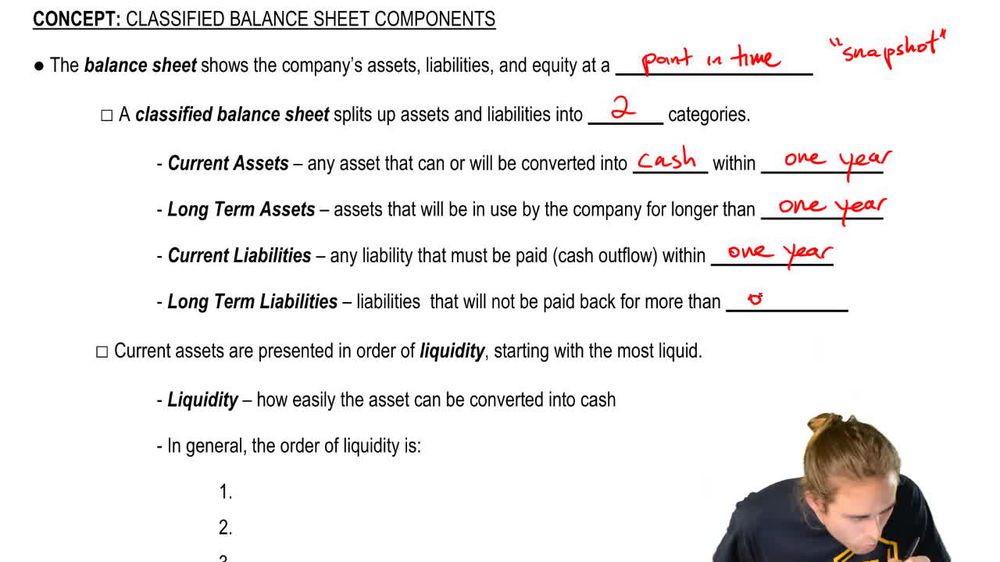
 06:38
06:38