Skip to main content
Financial Accounting
My Course
Learn
Exam Prep
AI Tutor
Study Guides
Flashcards
Explore
Try the app
My Course
Learn
Exam Prep
AI Tutor
Study Guides
Flashcards
Explore
Try the app
Back
Common-sized Statements definitions
You can tap to flip the card.
Common Size Statement
You can tap to flip the card.
👆
Common Size Statement
Financial report presenting each line item as a percentage of a base figure, enabling easy comparison across companies.
Track progress
Control buttons has been changed to "navigation" mode.
1/14
Related flashcards
Related practice
Recommended videos
Common-sized Statements quiz #1
Common-sized Statements
11 Terms
Common-sized Statements
14. Financial Statement Analysis
10 problems
Topic
Trend Percentages
14. Financial Statement Analysis
10 problems
Topic
14. Financial Statement Analysis
15 topics
15 problems
Chapter
Guided course
05:45
Common-sized Statements
1024
views
30
rank
Terms in this set (14)
Hide definitions
Common Size Statement
Financial report presenting each line item as a percentage of a base figure, enabling easy comparison across companies.
Vertical Analysis
Analytical method expressing each financial statement item as a percentage of a base amount within the same period.
Income Statement
Financial document summarizing revenues and expenses, typically using net sales as the base for percentage calculations.
Balance Sheet
Statement showing assets, liabilities, and equity, where items are often expressed as a percentage of total assets or total liabilities and equity.
Net Sales
Revenue figure used as the base amount for calculating percentages in common size income statements.
Total Assets
Sum of all resources owned by a company, often serving as the base for common size balance sheet analysis.
Total Liabilities and Equity
Combined value of obligations and owners’ claims, equaling total assets and used as a base in balance sheet analysis.
Cost of Goods Sold
Expense representing the direct costs of producing goods, often shown as a percentage of net sales.
Gross Profit
Difference between net sales and cost of goods sold, expressed as a percentage to assess profitability.
Operating Expenses
Costs incurred in running daily business operations, typically shown as a percentage of net sales.
Income from Operations
Earnings remaining after operating expenses, often presented as a percentage of net sales.
Net Income
Final profit after all expenses and taxes, commonly expressed as a percentage of net sales in common size statements.
Base Amount
Reference figure, such as net sales or total assets, used to calculate percentages for each line item.
Percentage Basis
Method of expressing financial data as proportions of a base amount, facilitating comparison across entities.
 BackBack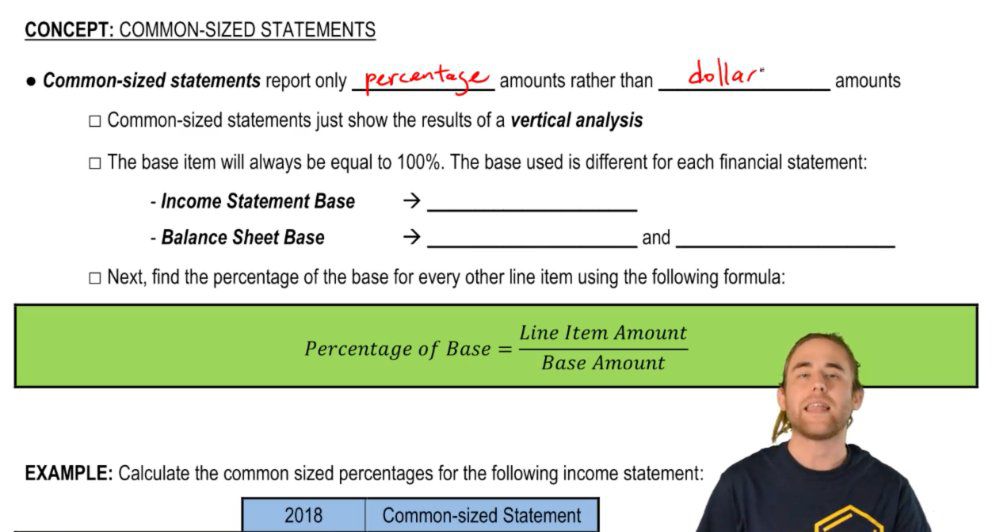
 05:45
05:45