Skip to main content
Financial Accounting
My Course
Learn
Exam Prep
AI Tutor
Study Guides
Flashcards
Explore
Try the app
My Course
Learn
Exam Prep
AI Tutor
Study Guides
Flashcards
Explore
Try the app
Back
Cost of Goods Sold - Perpetual Inventory vs. Periodic Inventory definitions
You can tap to flip the card.
Perpetual Inventory System
You can tap to flip the card.
👆
Perpetual Inventory System
Accounting method that updates inventory and cost of goods sold accounts immediately after each sale using real-time data.
Track progress
Control buttons has been changed to "navigation" mode.
1/15
Related flashcards
Related practice
Recommended videos
Cost of Goods Sold - Perpetual Inventory vs. Periodic Inventory quiz #1
Cost of Goods Sold - Perpetual Inventory vs. Periodic Inventory
26 Terms
Cost of Goods Sold - Perpetual Inventory vs. Periodic Inventory
4. Merchandising Operations
10 problems
Topic
Perpetual Inventory - Purchases
4. Merchandising Operations
10 problems
Topic
4. Merchandising Operations
11 topics
11 problems
Chapter
Guided course
03:41
Cost of Goods Sold:Perpetual Inventory
2470
views
55
rank
Guided course
05:53
Cost of Goods Sold:Periodic Inventory
2091
views
80
rank
Terms in this set (15)
Hide definitions
Perpetual Inventory System
Accounting method that updates inventory and cost of goods sold accounts immediately after each sale using real-time data.
Periodic Inventory System
Inventory method that updates inventory and calculates cost of goods sold only at the end of the accounting period.
Cost of Goods Sold
Expense representing the direct cost to acquire or produce items sold during a specific period.
Revenue Entry
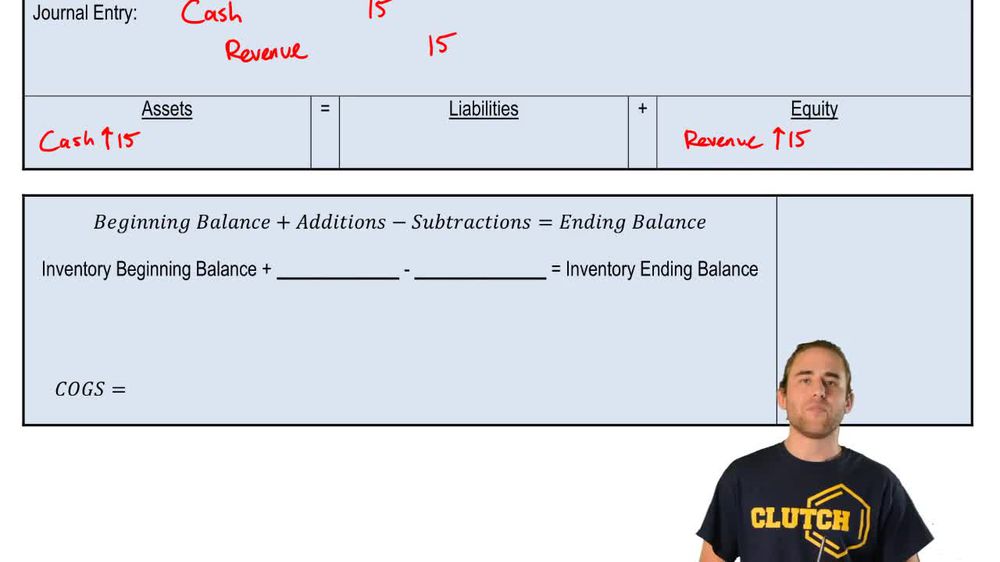
Journal entry recording the income received from sales, typically involving a debit to cash and a credit to revenue.
Inventory Account
Asset account tracking the value of goods held for sale by a business at any given time.
T Account
Visual tool used in accounting to represent debits and credits for a particular account, aiding in calculations.
Beginning Inventory
Value of inventory a company has on hand at the start of an accounting period.
Purchases
Additions to inventory during an accounting period, increasing the inventory account balance.
Ending Inventory
Value of inventory remaining unsold at the end of an accounting period, often determined by physical count.
Expense Account
Account type used to record costs incurred by a business, such as cost of goods sold, reducing equity.
Accounting Equation
Fundamental relationship: Assets = Liabilities + Equity, maintained through all accounting entries.
Physical Count
Process of manually counting inventory items to determine the actual quantity on hand at period end.
Debit
Accounting entry that increases asset or expense accounts and decreases liability, equity, or revenue accounts.
Credit
Accounting entry that increases liability, equity, or revenue accounts and decreases asset or expense accounts.
Asset
Resource owned by a business, such as cash or inventory, expected to provide future economic benefit.
 BackBack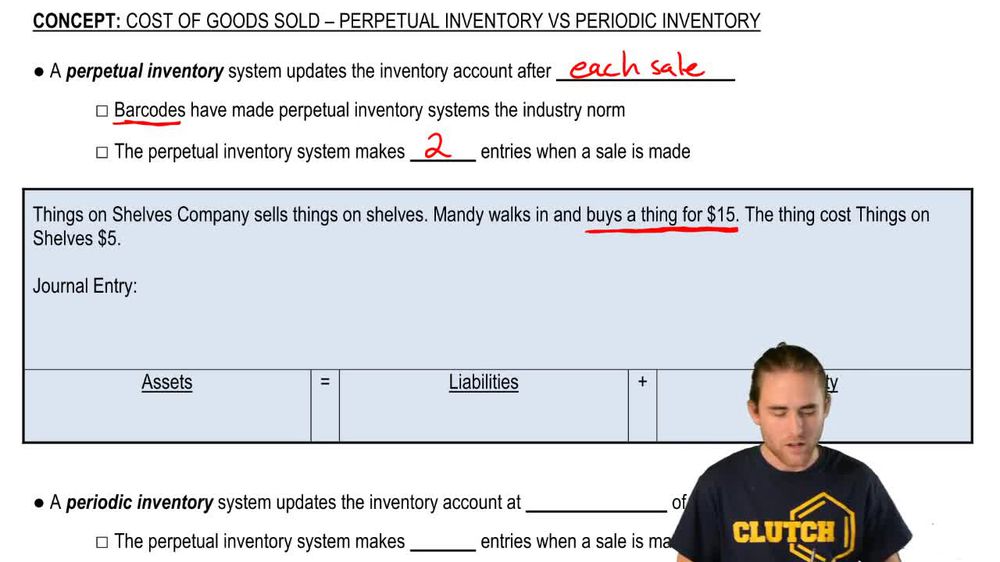
 03:41
03:41