Skip to main content
Financial Accounting
My Course
Learn
Exam Prep
AI Tutor
Study Guides
Flashcards
Explore
Try the app
My Course
Learn
Exam Prep
AI Tutor
Study Guides
Flashcards
Explore
Try the app
Back
Depreciation: Summary of Main Methods definitions
You can tap to flip the card.
Depreciation
You can tap to flip the card.
👆
Depreciation
Allocation of a fixed asset's cost over its useful life, reflecting wear and tear rather than cash outflow.
Track progress
Control buttons has been changed to "navigation" mode.
1/15
Related flashcards
Related practice
Recommended videos
Depreciation: Summary of Main Methods quiz #1
Depreciation: Summary of Main Methods
39 Terms
Depreciation: Summary of Main Methods
8. Long Lived Assets
10 problems
Topic
Depreciation for Partial Years
8. Long Lived Assets
5 problems
Topic
8. Long Lived Assets - Part 1 of 2
14 topics
15 problems
Chapter
8. Long Lived Assets - Part 2 of 2
1 topic
3 problems
Chapter
Guided course
08:31
Depreciation: Summary of Main Methods
926
views
22
rank
Terms in this set (15)
Hide definitions
Depreciation
Allocation of a fixed asset's cost over its useful life, reflecting wear and tear rather than cash outflow.
Straight Line Method
Depreciation approach that allocates an equal expense amount to each year of an asset's useful life.
Double Declining Balance
Accelerated depreciation method assigning higher expenses in early years and less in later years.
Units of Production Method
Depreciation method based on actual asset usage, such as miles driven or units produced.
Cost
Initial amount paid to acquire a fixed asset, forming the basis for depreciation calculations.
Useful Life
Estimated period over which a fixed asset is expected to provide economic benefits.
Residual Value
Estimated amount expected to be recovered at the end of an asset's useful life.
Non-Cash Expense
Accounting charge that does not involve an actual cash outflow, such as depreciation.
Net Book Value
Asset's recorded cost minus accumulated depreciation, not necessarily matching market value.
Depreciable Base
Total amount of an asset's cost minus its residual value, subject to allocation over its useful life.
Depreciation Expense
Portion of an asset's depreciable base allocated to a specific accounting period.
Accelerated Depreciation
Depreciation approach that allocates higher expenses in the early years of an asset's life.
Taxable Income
Amount of income subject to taxation after deducting allowable expenses, including depreciation.
Modified Accelerated Cost Recovery System
IRS-approved accelerated depreciation system, similar to double declining balance, used for tax purposes.
Fixed Asset
Long-term tangible resource used in operations, subject to depreciation over its useful life.
 BackBack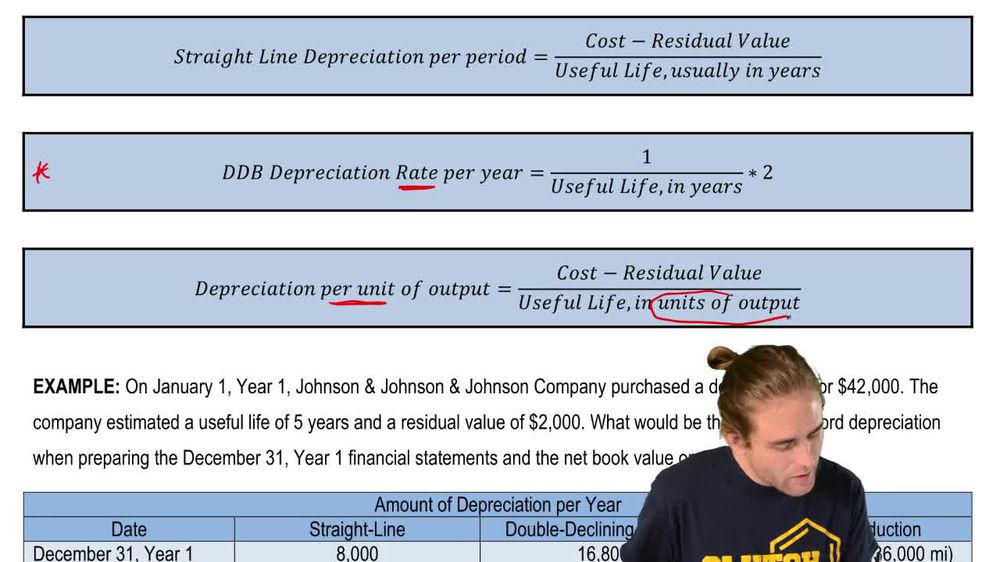
 08:31
08:31