Skip to main content
Financial Accounting
My Course
Learn
Exam Prep
AI Tutor
Study Guides
Flashcards
Explore
Try the app
My Course
Learn
Exam Prep
AI Tutor
Study Guides
Flashcards
Explore
Try the app
Back
Fraud and the Fraud Triangle definitions
1 student found this helpful
You can tap to flip the card.
Fraud
You can tap to flip the card.
👆
Fraud
Any dishonest act by an employee for personal gain at the expense of the employer, often involving theft or falsification.
Track progress
Control buttons has been changed to "navigation" mode.
1/14
Related flashcards
Related practice
Recommended videos
Fraud and the Fraud Triangle quiz #1
Fraud and the Fraud Triangle
40 Terms
Fraud and the Fraud Triangle quiz #2
Fraud and the Fraud Triangle
40 Terms
Fraud and the Fraud Triangle quiz #3
Fraud and the Fraud Triangle
40 Terms
Fraud and the Fraud Triangle
6. Internal Controls and Reporting Cash
10 problems
Topic
Sarbanes-Oxley Act
6. Internal Controls and Reporting Cash
10 problems
Topic
6. Internal Controls and Reporting Cash
8 topics
15 problems
Chapter
Guided course
04:54
Fraud and the Fraud Triangle
2282
views
102
rank
1
comments
Terms in this set (14)
Hide definitions
Fraud
Any dishonest act by an employee for personal gain at the expense of the employer, often involving theft or falsification.
Fraud Triangle
A model outlining the three essential elements—opportunity, incentive, and rationalization—required for fraudulent behavior.
Opportunity
A situation where an employee perceives a chance to commit fraud, often due to weak controls or oversight.
Incentive
A motivating factor, such as financial pressure or desire for luxury, that drives an employee to commit fraud.
Rationalization
The mental process by which an employee justifies dishonest actions, often citing unfair treatment or personal hardship.
Internal Controls
Systems and procedures within a company designed to safeguard assets, ensure reliable records, and promote legal compliance.
Asset Safeguarding
Measures implemented to prevent unauthorized access to or removal of company resources like cash or inventory.
Financial Information Reliability
The accuracy and trustworthiness of a company's financial records, enhanced by effective internal controls.
Compliance
Adherence to laws and regulations, often ensured through company policies and internal procedures.
Cash Register
A point-of-sale device that must be monitored and reconciled regularly to prevent and detect theft.
Inventory
Goods or materials held by a company that can be targets for theft or misappropriation in fraudulent schemes.
Fake Invoice
A falsified billing document created to illicitly divert company funds, often appearing legitimate if unchecked.
Policy
A formal guideline or rule within a company that directs employee behavior and supports internal controls.
Procedure
A specific method or process established to ensure tasks are performed correctly and consistently, reducing fraud risk.
 BackBack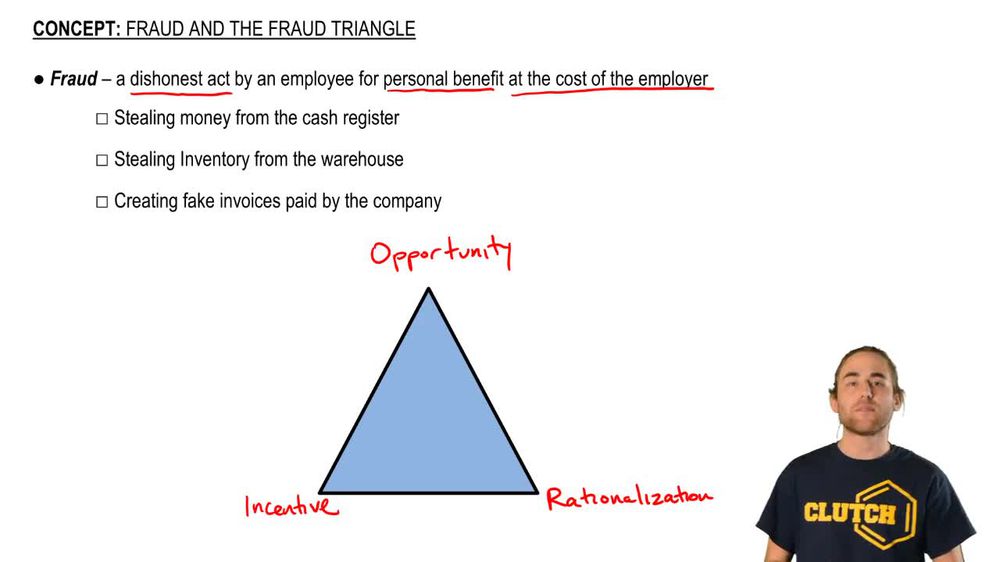
 04:54
04:54