Skip to main content
Financial Accounting
My Course
Learn
Exam Prep
AI Tutor
Study Guides
Flashcards
Explore
Try the app
My Course
Learn
Exam Prep
AI Tutor
Study Guides
Flashcards
Explore
Try the app
Back
GAAP vs. IFRS: Analysis and Income Statement Presentation definitions
You can tap to flip the card.
GAAP
You can tap to flip the card.
👆
GAAP
US accounting framework established by FASB, characterized by detailed, rules-based standards for financial reporting.
Track progress
Control buttons has been changed to "navigation" mode.
1/15
Related flashcards
Related practice
Recommended videos
GAAP vs. IFRS: Analysis and Income Statement Presentation quiz
GAAP vs. IFRS: Analysis and Income Statement Presentation
15 Terms
GAAP vs. IFRS: Analysis and Income Statement Presentation
15. GAAP vs IFRS
10 problems
Topic
GAAP vs. IFRS: Statement of Cash Flows
15. GAAP vs IFRS
10 problems
Topic
15. GAAP vs IFRS
11 topics
11 problems
Chapter
Guided course
05:09
GAAP vs. IFRS: Analysis and Income Statement Presentation
617
views
3
rank
Terms in this set (15)
Hide definitions
GAAP
US accounting framework established by FASB, characterized by detailed, rules-based standards for financial reporting.
IFRS
International accounting standards set by IASB, emphasizing a principles-based approach and global comparability.
FASB
US organization responsible for developing and issuing the official accounting standards known as GAAP.
IASB
International body that formulates and updates IFRS, aiming for consistency in global financial reporting.
Horizontal Analysis
Analytical method comparing financial data across multiple periods to identify trends and growth patterns.
Vertical Analysis
Technique expressing each item in a financial statement as a percentage of a base figure within the same period.
Ratio
Quantitative relationship derived from financial statement figures, used to assess performance and position.
Operating Items
Transactions and events arising from a company's core, day-to-day business activities.
Unusual Items
Non-recurring transactions or events not part of regular business operations, such as one-time losses or gains.
Discontinued Operations
Segments of a business that have been disposed of or are held for sale, reported separately from ongoing activities.
Change in Accounting Principle
Switch in accounting methods, requiring retroactive adjustment to prior financial statements for comparability.
Change in Accounting Estimate
Revision of a previous judgment or assumption, applied prospectively without altering past financial statements.
Comprehensive Income
Total financial performance including net income and other items like unrealized gains and losses not in net income.
Revaluation
Adjustment of the carrying value of long-term assets to reflect current fair value, permitted under IFRS.
LIFO
Inventory valuation method where the most recently acquired items are assumed sold first; not allowed under IFRS.
 BackBack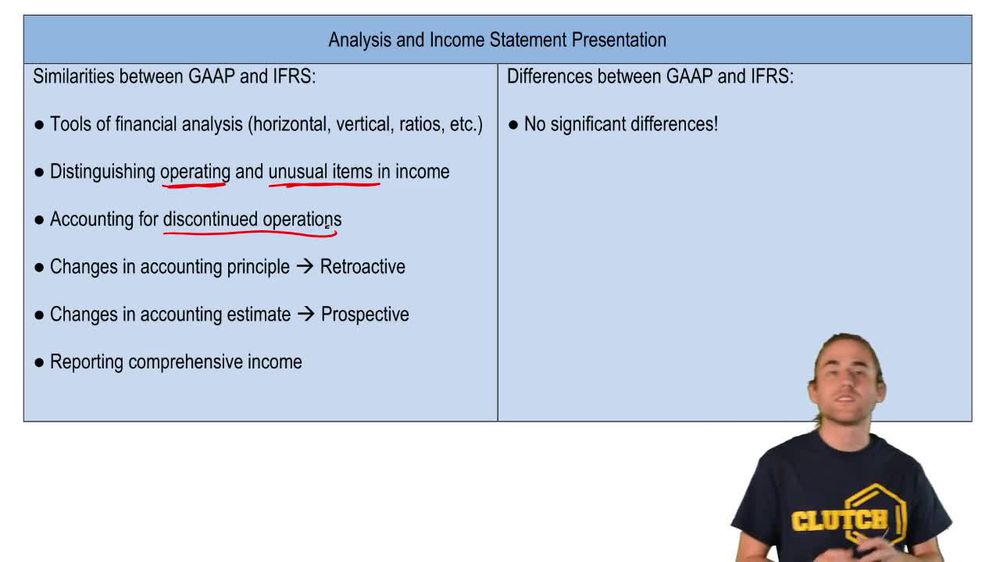
 05:09
05:09